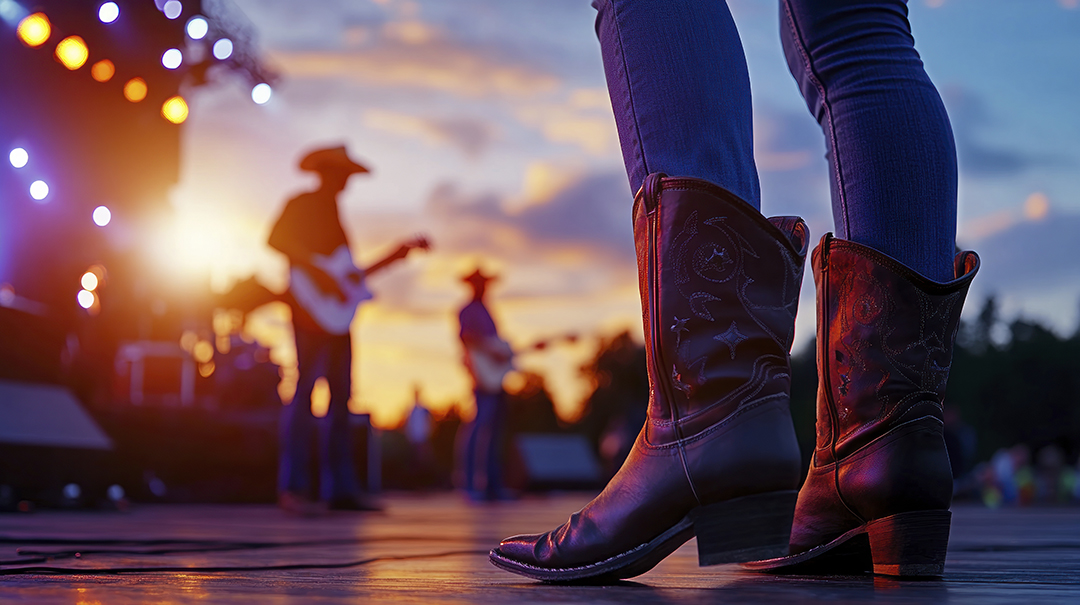
There’s a place, west of Kendall County, where boots clack on concrete, and necks sweat from the heat of dancing. Every summer, at Garner State Park, up the bending hill and past the stretch of construction, there’s a dance at the CCC Pavilion.
The pavilion is older than anyone dancing in it. Limestone and bald cypress, built in the 1930s, set on a perch over the Frio River. The dances have run every summer for so long that nobody questions them anymore. You just go. The heat wiggles into the room between your shins and boots, across your back, into the clamped hands of a couple already out on the floor. You haven’t really experienced Texas until you’ve danced at Garner on a Saturday night.
Grandparents line the walls in faded folding chairs, fanning themselves as they watch. Parents two-step with toddlers balanced on their boots. Little girls spin with their dads while married couples who’ve probably danced here for decades wait for the next song. It’s one of the few places where every generation shares the same dance floor.
Chairs get camped out hours early, front row seats to the headliners of the night: teenagers. We gather around The Bar, the understood place to stand if you want to be asked to dance. A broad tree splits it down the middle. Little kids on the left. Teenagers on the right.
I stand to the right when I’m there with my family. Skin itchy from sweat, trying to find a casual way to stand. So I wait. And I watch to see if a boy will walk over.
The rest of the year, I’m not at Garner. I’m at Boerne High, where the asking happens through a screen, or it doesn’t happen at all. A boy will “snap” a girl for weeks. Months, even. Selfies back and forth, a streak counting up like it means something. Then they pass in the hallway and look at the floor. Two people who’ve technically talked every day, walking past each other like strangers. I’m not above it. My phone does the same thing in my pocket. It’s easier to send a picture than to say a word.
But at Garner, the phone goes quiet. No service in the canyon, no buzz, no streak about to die. The data there is bad, and somehow everything else gets better.
Here’s what I figured out standing at that bar. The screen feels like the safe choice, and it isn’t. The dancefloor feels like the scary one, but it isn’t either. At Garner, I’m dancing with boys I’ll never see again. He doesn’t know my friends. There’s no group chat tomorrow, no screenshot, nothing on the line. That’s exactly why it works. When there’s nothing to lose, a boy can just be brave. He crosses the floor, puts his hand out, and the worst thing that happens, which never really does, is a polite no and a song he sits out. I’ve never known a dating culture like it anywhere else.
So they ask. And we say yes. Every boy asks a new girl each dance, and every girl takes his hand. You don’t wait long.
The boldest ones out there are the little boys. My ten-year-old brother marches straight up to a teenage girl twice his height and asks her to dance, and she always says yes. So do all the other little boys, a whole crew of them, leading girls who tower over them around the floor, steering with total confidence like the height difference is the girl’s problem to sort out. They haven’t learned to be scared yet. Nobody’s told them a ten-year-old can’t ask a sixteen-year-old to dance, so they just do it, and it works every single time. Watch them long enough, and you start to wonder what happens to a boy between ten and seventeen that makes the walk across the floor feel impossible. The fear isn’t natural. It’s learned somewhere along the way.
It’s loud, so you yell into each other’s ears. You ask the normal things. What sports do you play? Where are you from? How long are you here? He says a town you’ve never heard of and a date he’s leaving, and you know the whole time that this is all you get. Then the song ends, he spins you, and you part ways. When the heat gets to be too much, there’s an ice cream shop, and a little gift shop I love to slip into for some quiet. Then you go back to the bar and do it again with someone new.
I think about those boys a lot. Not the ten-year-olds. The older ones, the ones my age, who walk over without knowing me and ask anyway. There’s a respect in it, I don’t think they realize they’re giving. It never mattered to me whether there was some spark or whether I’d remember his name by the next song. He walked over. That was the whole thing. And every girl at that bar, sweating and pretending she isn’t watching the crowd, is hoping she’s the one he picks.
I wish the boys back home could see it. Not to feel bad, just to know it’s there. Half of them have spent so long letting an app do their talking that the walk across a room has started to feel like more than it is. But it’s the rarest thing now, a boy who can look at you and just ask. You notice him immediately. He stands out without trying, in a way no streak ever made anyone stand out.
And I don’t think it’s a Garner thing, really. I think it’s a muscle. The first ask is terrifying, and the tenth is nothing, and a summer of it leaves you the kind of person who can look someone in the eye and want something out loud. That doesn’t stay at the park. It follows you into the fall, into whatever comes after high school, into rooms full of people who’ve never heard your name. The boys who learned it will walk in easily. The ones still hiding behind a phone will stand at the edge, the way they always have.
So I think about the boy from the hallway, the one who “snapped” her for months and never said “hi”. I put him at Garner. The phone’s dead in his pocket. The song starts. She’s standing to the right of the tree, hoping.
Go ask that girl to dance.
Addison Schuepbach is a 17-year-old senior at Boerne High School. She’s an Eagle Scout, an avid reader, and loves writing. She runs hurdles for track and enjoys playing tennis.
From the August 2026 issue of The Kendall Gentleman.
Addison Schuepbach’s essay joins The Kendall Gentleman’s BetterMENt series, following recent entries like BetterMENt: Rebuilding from the Rubble of Moral Failure and BetterMENt: Before It Becomes a Memory. Elsewhere in this issue, Stan Leech reflects on forty-five years of marriage in Slow, Quick, Quick, Slow.