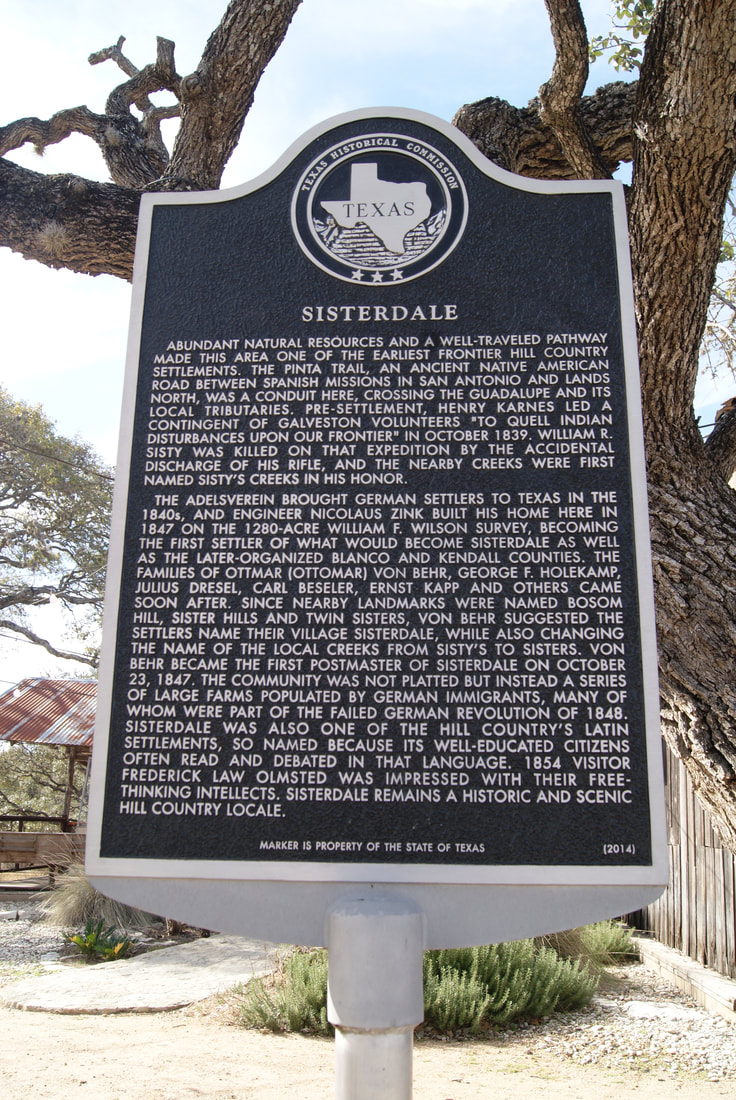
History is often measured by battles won, elections decided, or fortunes accumulated. Yet sometimes history is made quietly, in places so small they scarcely appear on a map. Sisterdale, nestled among the limestone hills of western Kendall County, is one of those places.
Today, motorists pass through this peaceful Hill Country community without realizing that, during the middle years of the nineteenth century, Sisterdale became home to one of the most intellectually remarkable settlements on the American frontier. Farmers discussed philosophy after working their fields. Musicians gathered around pianos transported over rough wagon roads. Teachers, physicians, engineers, journalists, political reformers, and scholars built homes beside craftsmen and ranchers.
“Few places in Texas can claim to have influenced ideas that reached around the world. Sisterdale is one of them.”
Together they created what became known as one of Texas’s famous Latin Settlements—not because of their ancestry, but because many possessed classical European educations grounded in Latin, Greek, philosophy, literature, and science. Their conversations often ranged from Plato and Goethe to crops, livestock, and the challenges of frontier life.
Among these remarkable pioneers was Dr. Ernst Christian Kapp, a German educator, philosopher, political reformer, and one of Sisterdale’s most influential early citizens. Although his international reputation rests largely upon books he published after returning to Germany, many of the experiences that shaped those ideas were lived here in Kendall County.
From Bavaria to the Texas Frontier
Ernst Kapp was born on October 15, 1808, in Ludwigstadt, Bavaria. An exceptional student, he studied under the distinguished geographer Carl Ritter, whose work helped establish modern geography as an academic discipline. Kapp pursued careers in education and philosophy while becoming increasingly involved in the democratic reform movement sweeping the German states during the Revolution of 1848.
The revolution sought constitutional government, freedom of the press, expanded civil liberties, and representative government. When the movement failed, many of its leaders faced imprisonment or exile. Like thousands of educated refugees who later became known as the Forty-Eighters, Kapp chose to leave Europe rather than surrender his principles.
In 1849, Ernst Kapp, his wife Ida Kapell Kapp, and their five children landed in Galveston before making their way into the Texas Hill Country.
A Settlement Unlike Any Other
One of the most common misconceptions about Sisterdale is that Ernst Kapp founded the community.
He did not.
Historical records show that Sisterdale had already been established in 1847 by engineer and surveyor Nicolaus Zink, who built the settlement’s first cabin. Kapp arrived shortly thereafter, purchasing land that included Zink’s original homestead. While he was not the founder of Sisterdale, he quickly became one of its most influential residents and helped shape its unique intellectual character.
Other remarkable settlers soon joined him, including Ottomar von Behr, Adolph Douai, Julius Fröbel, August Siemering, and numerous other educators, writers, musicians, scientists, and political reformers. Their shared love of learning transformed a remote frontier settlement into one of the most unusual communities in Texas.
Why Was Sisterdale Called a “Latin Settlement”?
The term had nothing to do with nationality.
Instead, it reflected the classical education of many residents, who had studied Latin, Greek, philosophy, literature, and science at European universities. Visitors often remarked that conversations about Plato, Goethe, Beethoven, and Shakespeare were as common as discussions of farming and ranching.
Building a New Life
Like every immigrant who settled in the Texas Hill Country, Ernst Kapp soon discovered that survival demanded practical skills as well as intellectual ability.
The university-trained scholar became a farmer, builder, stock raiser, and community leader while continuing to read, write, and participate in Sisterdale’s lively discussions.
One of his most unusual ventures was Badenthal, or “Valley of the Springs.” There he established a hydropathic retreat based upon the nineteenth-century European practice of therapeutic water treatments. Patients came seeking improved health through fresh spring water, exercise, clean air, and rest.
Although hydropathy has largely disappeared from modern medicine, it represented one of Europe’s respected wellness movements during Kapp’s lifetime. Today, the restored Kapp home remains one of Kendall County’s most significant historic landmarks.
A Community That Thought for Itself
The residents of Sisterdale were not merely educated—they were independent thinkers.
In 1853, Ernst Kapp was elected president of the Freier Verein (Free Society), an organization of German intellectuals in Texas. The society advocated expanded public education, freedom of conscience, separation of church and state, and broader civil liberties. It also opposed the expansion of slavery, a position that generated considerable controversy in pre-Civil War Texas.
Whether one agreed with their political views or not, there is little question that these immigrants brought thoughtful debate about citizenship, education, and democratic government to the Texas frontier.
A Distinguished Visitor
One visitor captured Sisterdale better than anyone else.
In February 1854, journalist Frederick Law Olmsted traveled through Texas while gathering material for what would later become A Journey Through Texas. Years before gaining worldwide recognition as the co-designer of New York City’s Central Park, Olmsted arrived in Sisterdale expecting another frontier farming community.
Instead, he discovered something entirely different.
He found educated immigrants who discussed literature, philosophy, music, and politics after spending their days clearing fields and tending livestock. Olmsted later described them as “free-thinking, cultivated, brave men.” His observations remain among the finest contemporary descriptions of early Sisterdale and helped introduce the community to readers far beyond Texas.
Ideas That Reached Around the World
Following the Civil War, declining health prompted Ernst Kapp to return permanently to Germany in 1865.
There he resumed his scholarly career and published several important works. In 1877 he completed Grundlinien einer Philosophie der Technik (Foundations of a Philosophy of Technology).
Many historians regard this book as the foundational work of the philosophy of technology because it systematically explored how tools and machines extend human capabilities. A hammer extends the hand. A telescope extends the eye. Transportation extends human mobility.
More than a century later, scholars studying technology, media, artificial intelligence, and human-machine interaction continue to discuss ideas first articulated by Ernst Kapp.
It is remarkable to consider that many of those ideas were refined while their author farmed rocky soil, built fences, and raised a family in Kendall County.
A Legacy Worth Remembering
Today, motorists pass quietly through Sisterdale on Ranch Road 1376, often unaware that this peaceful valley once attracted scholars, musicians, physicians, scientists, and political reformers whose influence extended far beyond Texas. The community never became large, nor did it seek fame. Yet for a remarkable moment in the nineteenth century, it stood as one of the most intellectually distinctive settlements on the American frontier.
Ernst Kapp never sought recognition as a Texas pioneer. He came because revolution had cost him his homeland. Here, among the limestone hills and clear springs of Kendall County, he found both refuge and opportunity. He farmed, built a home, raised his family, welcomed visitors to Badenthal, and helped shape a community that believed education, independent thought, and civic responsibility were as essential to frontier life as hard work and perseverance.
More than 175 years later, the story of Ernst Kapp reminds us that Kendall County’s history reaches far beyond ranches, railroads, and frontier settlements. It is also the story of ideas—ideas carried across an ocean by men and women willing to begin again.
Those ideas found fertile ground along Sister Creek, where a quiet Hill Country community demonstrated that learning and liberty could flourish together even on the edge of the Texas frontier.
That legacy remains one of Kendall County’s greatest—and least appreciated—historical treasures.
From the September 2026 issue of The Kendall Gentleman.
Sisterdale’s Latin Settlement history connects to Men of the Hill Country: Kendall County’s Legacy in America’s 250-Year Story and to Nicolaus Zink, who appears in this article and in Nicolaus Zink: A Pioneer of Kendall County Texas. Readers may also recall an earlier look at the same settlement, The Sage of Sisterdale: Ernst Kapp.