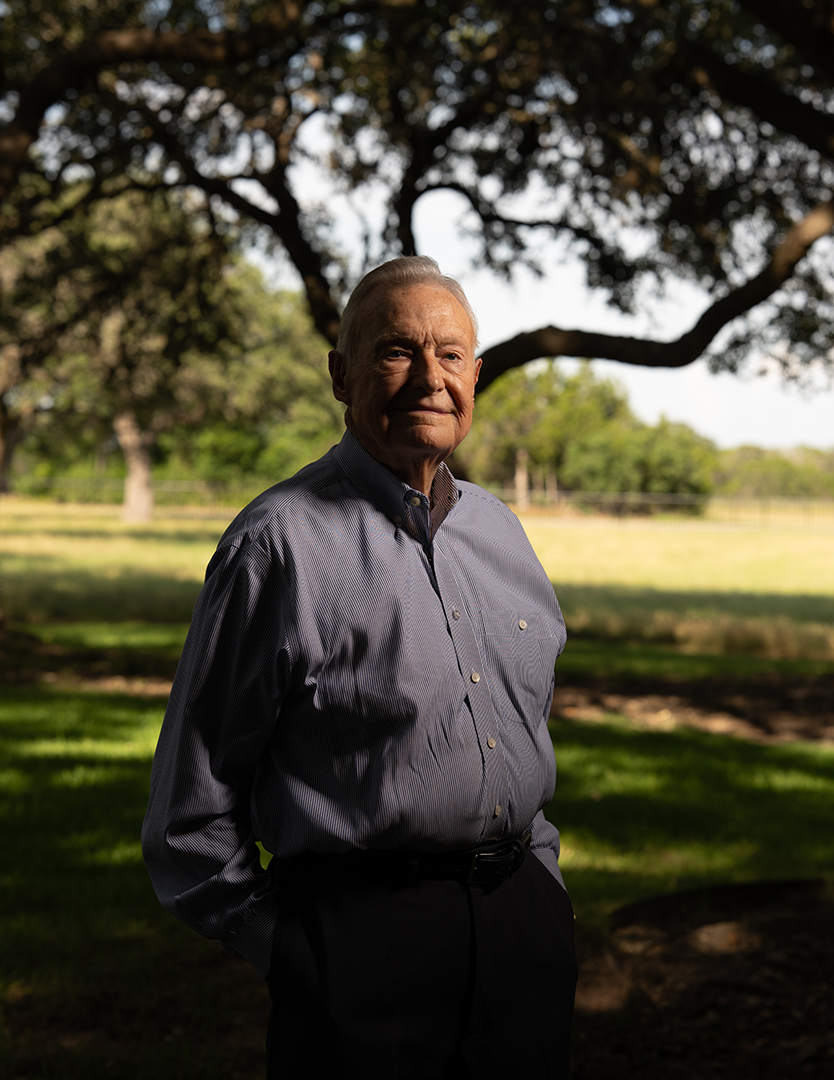
I spent four and a half hours with Bill Thomas, and I left knowing I had only heard the beginning. That does not happen often. Most interviews eventually settle into a pattern: childhood, career, hardship, lesson learned. Bill does not speak that way. He tells his life as work remembered in motion: cattle gathered, pipe bought, credit extended, bids won, churches built, roads fought, prayers offered, and one woman loved for a lifetime.
He is 95 now, born in 1930, and the broad shape of his life is easy to describe. He was a Burleson County ranch kid, an Air Force cryptography man, a pipe businessman, a cattleman, a husband, a churchman, and a Boerne patriarch. But the truth about him is not in the titles. It is in the doing.
Bill was born near Somerville, Texas, on a cattle ranch in Burleson County. His grandfather, also named William F. Thomas, stepped into the room after he was born and said, “This one will be William F. Thomas.” Bill still carries that name with reverence. His grandfather, he says, was “a God-fearing man with integrity,” and integrity is one of those words that keeps returning when Bill talks. It is not decoration; it is foundation.
By three or four years old, he was riding behind his father on horseback, learning cattle the way some boys learn ballplayers. He could look across a herd and know which animal was missing. “I just knew the cattle,” he says. That old instinct never left him. Long before he became known in pipe, he was a stockman, and in his mind, the two identities never competed. When asked once what he really knew about the pipe business, Bill answered, “If you cut my head open, half of it would be pipe rolling out of it, and the other half would be cattle. But I say my vocation is pipe.”
That vocation took time. After Somerville High School, Blinn Junior College, and a short stretch at the University of Houston, Bill joined the Air Force at 19 in 1951. He trained at Lackland, moved through Colorado and Cheyenne, and was placed in top-secret cryptography work. He remembers being tested by “plants” who tried to get him talking. He did not.
He also remembers Joyce. While stationed in Cheyenne, he called her in Texas and told her to come. She climbed on a train by herself and did exactly that. They married in Wyoming in 1951. Later, he was stationed at Offutt Air Force Base in Omaha, headquarters of Strategic Air Command under Gen. Curtis LeMay, one of the nerve centers of the Cold War.
After the service, Bill returned to Texas and moved to Houston in 1956. At Atlas Bradford, he entered the pipe business in a useful way, from the inside. He learned inspection, scheduling, shop flow, sales, and the daily mechanics of a plant. “I’m going to put you where you’ll know what to do,” he remembers being told. That training mattered. Bill did not learn business from slogans. He learned it close to the work, where mistakes have weight.
From Houston came Uvalde. From Uvalde came Gensco. And from Gensco came the shape of his fortune. The company had access to huge amounts of pipe through a Mexican mill arrangement at Eagle Pass, but lacked the systems needed to grow. Bill helped build them: memorandums, purchase orders, invoices, bidding, inventory control, and national wholesale reach. He still tells those stories with the precision of a man who can see the paper in front of him.
One of the biggest was a 328-mile Colorado Interstate pipeline replacement job. Bill helped structure the bid so the company could pursue the work without being destroyed by its size. That was one of his gifts. He could see both the opportunity and the danger. Whether he was talking about a ranch, a pipeline, or a church, his instinct was the same: put order where there is disorder, build structure first, then move.
In 1976, after years in the trade, Bill started Joy Pipe. The name came from Joyce, of course, but it became something more. “It’s your name,” he told her. “But it also means J for Jesus first, O for others second, and yourself last. That’s true JOY.” So Joy Pipe was a business name, a family creed, and a statement of faith.
“But it also means J for Jesus first, O for others second, and yourself last. That’s true JOY.”
As part of his transition out of Gensco, Bill agreed not to sell into Texas and eight other states, so he went elsewhere. He knew the mills, the buyers, the inventory, and the market well enough to bet his life on it. LTV later gave Joy Pipe an exclusive arrangement to sell its secondary pipe, material with imperfections that had to be represented honestly. Bill says that honesty was why the deal came his way. He would call it what it was, sell it for what it was, and not pretend it was prime. In a business where exaggeration can move faster than a rail car, Bill’s word became part of the product.
One month, he says, Joy Pipe sold 67 rail cars. Later, the company bought a 107-mile pipeline in Ohio, refurbished the pipe, and sold 530 loads to Milwaukee and another 90 to Birmingham. Years after Joy Pipe began, the business restructured into Joy Pipe USA, with the original Joy Pipe holding accumulated capital and investments. Protection mattered to him. Build something, guard it, keep going.
But business was never the whole of him. Running beside the pipe trade was a cattle life measured in decades: Hereford heifers from his father, the move into Brangus, dispersal sales, bargain buys during hard oil years, and the patience to recognize quality when the market was panicking. That is the ranching side of Bill Thomas, part instinct, part discipline, part belief that God still has a hand in where the best stock ends up.
Boerne entered the story through loyalty, not strategy. In 1995, Joy Pipe moved from Uvalde to Boerne because his son-in-law, Tom Bibb, wanted a better school system for his children. Bill’s answer was simple. If the man needed to move, the company could move too. They loaded the furniture in Uvalde on Friday, placed it in Boerne on Saturday, and were back in business Monday morning. It says something exact about Bill. He was not only building a company. He was building a culture where people mattered enough to move with.
Boerne also gave him a public role. Bill helped defeat two separate TxDOT loop proposals in Kendall County, first around 2007 and later again under a different county administration. He saw those fights as local, practical, and personal. In his view, the loops were unnecessary, secretive, and harmful to the county. That pressure has not gone away. Kendall County still wrestles with growth, roads, land, traffic, and the question of who gets to decide what kind of place this will become. Bill understood that early. He did not oppose every change. He opposed the kind that arrives already decided.
Then there is Joyce, who is not a side note in this story. She is its quiet center. Bill says she died on April 28, 2021. He buried her at Bethlehem Lutheran Church in William Penn, northeast of Brenham, where her family was buried and where he plans to be buried too. Afterward, he funded a major refurbishment of Messiah Lutheran Church in Boerne, modeling parts of it after a church Joyce loved near Brenham. He describes the gift not as philanthropy, but as a memorial, a devotion, and a duty.
That same seriousness runs through how he talks about people. Bill says he gave Rooster McConaughey his start by extending credit when Rooster was beginning. “How much credit do you need?” Bill remembers asking. Then he told him, “You got it, just run with it.” He does not tell that as charity. He tells it as business done the old way: take a man seriously before the world has decided whether he matters.
After four and a half hours, I understood why men listen to Bill Thomas. It was not because he was loud, because he was not. It was not because he was trying to impress me, because he was not. It was because every story seemed to carry a lesson earned the hard way. I could have sat there another four and a half hours. Maybe longer. Maybe a lifetime. Some men are wells of wisdom, and you know early on that you will run out of bucket before they run out of water.
Late in the interview, I asked him what advice he would give the men of Kendall County. He did not wander around the answer. “Go forward with the strength of the Lord behind you,” he said. Then he added, “Let Him help you make your decisions, and He will make the right decision for you.” When I asked what he would tell a young man, he said, “First of all, be faithful and absolutely know his talents. And when he selects the best talent in him, pursue it with all vigor. Don’t look back.”
Then he told me how he thinks about Joyce. “When we were married,” he said, “God gave us two tickets to ride His train together through life.” They rode that train together, he said, to God’s glory and to the fulfillment of their life. Joyce has reached her destination. Bill is still riding.
That may be the truest ending. Bill Thomas has built companies, raised cattle, backed men, fought for land, loved one woman, honored God, and given more to Boerne than most people will ever know. But he does not speak like a man standing among ruins. He speaks like a man still under orders, still called to move while the Lord leaves him here to work.
He built Joy, and he is still on the train. And this month, we’re honored to mark one stop along that remarkable journey by recognizing Bill Thomas as The Kendall Gentleman.
Key Facts
- Full name: William F. Thomas
- Born: near Somerville, Texas
- Roles: founder of Joy Pipe; cattleman; former Air Force cryptographer
- Issue: August 2026
From the August 2026 issue of The Kendall Gentleman.
Bill Thomas’s reflections on integrity carry directly into this month’s Publisher’s Note, A Man’s Word. His story joins a growing list of Kendall Gentleman cover profiles, including Still Standing: The Scott Carlson Story and Find a Way: The Making of Jordan Ballin.
1 thought on “The Man Who Built Joy”
Comments are closed.