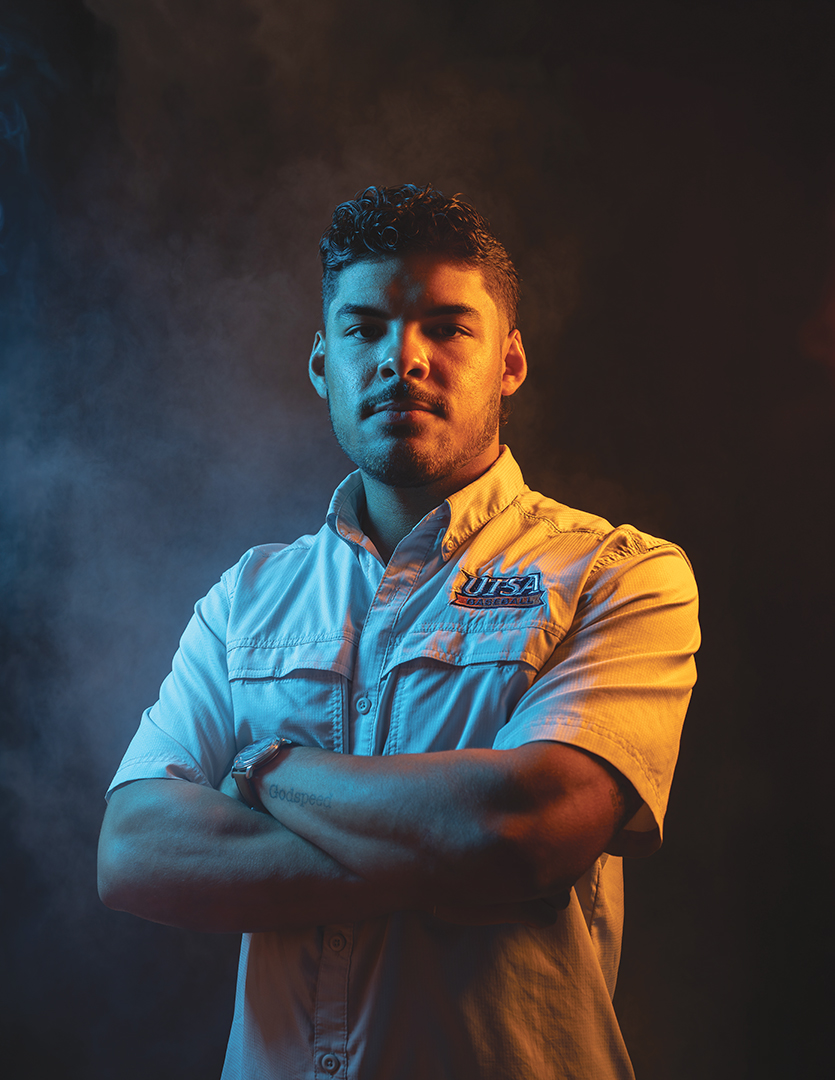
In Kendall County, people don’t hand out respect easily.
They’ll notice talent. They’ll show up on a Friday night and watch a kid throw it, hit it, or run past everybody on the field. But respect is a different transaction. It takes time, and it usually comes down to one question that nobody asks out loud.
Can I trust him?
That’s the word that keeps following Jordan Ballin around Boerne. Not in a billboard kind of way. In the quiet way people talk when they’ve watched somebody long enough to know who he is. Coaches use it. Teammates use it. Younger players use it.
Leader.
Not because he’s been trying to be one. Because at some point he realized people were watching, and he decided to carry himself like it mattered.
At twenty years old, having Jordan as our youngest cover story subject yet is quite exciting. He was born in San Antonio at St. Luke’s Hospital in the spooky stretch of October. His dad was working a haunted house at the time. His grandmother had to call him there and tell him to get to the hospital. He made it.
Jordan’s parents were teen parents. His mom had him at seventeen. His dad was eighteen. Both were collegiate-level basketball players in Amarillo, his dad at Caprock and his mom at Randall. Both had basketball futures lined up. Neither of those futures survived contact with a baby.
“Our joke is that we all grew up together,” Jordan said. “Just the three of us.”
His parents shelved the basketball plans, moved to San Antonio when his grandfather got a management opportunity, and got to work. Both eventually attended UTSA. The same UTSA Jordan now plays for. The same campus he wandered as a four-year-old, sitting in their classes, getting treated like, in his words, “a little adult.” He still sits in the same classrooms his parents sat in. Some of the desks probably haven’t changed either.
People comment on Jordan’s maturity like it’s a trait he was born with. It isn’t. It’s a habit. The kind that gets built when your parents are still in their twenties and you’re already at the table.
Jordan grew up surrounded by sports. Football, baseball, basketball, soccer, whatever was in season. There wasn’t a quiet weekend in the Ballin house. There also wasn’t a losing mentality. The family lived by a phrase Jordan now wears on his glove and has tattooed on his body.
Find a way.
Sophomore year of high school, Jordan was in a slump. He had come off a strong freshman season, made varsity as a freshman, and was starting to believe he belonged. Then the hits stopped falling.
After one rough game he came home and sat with his parents on the back porch. They were hard on him. They have always been hard on him, and he says it the way a man says it when he knows it was the right kind of hard.
At the end of the conversation, his mom looked at him and said, “At the end of the day, you just gotta find a way.”
Then she added the line that anchored it.
“How do you think me and your dad felt when we had you? We found a way to raise the man you are today. We’re not going to stop now.”
A slogan changes when the situation changes. A standard doesn’t. That was the moment “find a way” became Jordan’s standard.
He’s living inside it right now. Two surgeries in the past few months, one for a broken hamate bone in his hand at the end of last season, another for a fractured leg in the fall. Most kids would take the redshirt. Jordan was back weeks early, rehabbing and playing at the same time, and got the start on opening day.
When the press asked him about it after a recent walk-off win, he gave them a sentence he had clearly thought about a long time.
“The past brings you depression. The future brings you anxiety. So you just gotta live in the moment. Be where your feet are.”
He doesn’t describe his realization that he was a leader as a single moment. But if you press him, he’ll tell you the seed was planted when his brother Jackson was born.
That was third grade. He still remembers being pulled out of Mrs. Stewart’s class, his grandmother in the front office, and the words “Jackson’s here.” Cinco de Mayo. The two of them are ten years apart, and Jordan calls his brother’s birth one of the best moments of his life.
His parents told him something that day that ended up shaping everything after. There’s another set of eyes on you now. Whatever you do, he’s going to do. So decide what you want him to see.
By middle school, Jordan had become the guy his tight friend group went to when something was breaking down. Coach Harbuk handed him an award at South that he still thinks about. The line that stuck wasn’t about his stat sheet. It was that Jordan was the kind of player who could lead from the front and still pick up the ones struggling in the back. Two skills that don’t usually live in the same body.
The leadership got tested in football. Junior year at Champion, after most of the seniors had graduated, the locker room started talking like the season was already lost. Jordan pushed back without raising his voice.
“The season hasn’t even started, and you’re saying this. Why don’t we just play? Why don’t we use what we have to our advantage?”
Some guys lead by yelling. Jordan leads by suggesting. He doesn’t tell teammates what to do. That’s a coach’s job. He offers a way to think about it, then goes and does the thing himself. When his team wins, he never says “I won the game.” He says “we won the game.” He calls it quiet leadership. You can scan the field and not pick him out as the leader at first. You’ll figure it out by the third inning.
The other defining football moment came senior year, in a game that wasn’t going Champion’s way. Jordan’s offensive coordinator, Coach Brown, was outwardly calm. Jordan wasn’t.
Brown looked at him and said, “Look at me. Do I look upset?”
“No, sir.”
“Then why are you upset?”
He waited a beat and drove it home. The leader’s demeanor sets the demeanor of the team. If the leader is mopey, the team is mopey. If the leader is composed, the team has somewhere to look.
Jordan still carries that conversation. He says it like a young man who has decided being the kind of person younger people watch is not optional.
“You gotta be the person you want your kids to be when they’re older.”
He is twenty years old when he says this.
The first college offer came his freshman year of high school. Other offers followed. None of them mattered the same way.
UTSA was already home. His parents had bled orange and blue for years before he was old enough to know what the colors meant. His brother Jackson now serves as bat boy at UTSA games, the same role he played in high school. The family that started in a haunted house and a hospital twenty years ago all sits in the same set of seats now.
Last spring, UTSA went to a regional. Nobody picked them to. They were a mid-major in a state that worships the schools with the practice facilities and the NIL money. They beat Texas. The last pitch was thrown, the strikeout was called, and the dugout exploded.
Jordan stayed back for a moment after the celebration. He sat there and looked at the empty field, the lights still on, the scoreboard reading UTSA WINS. He says it didn’t fully land until that quiet moment.
“Nobody thought we would be in a regional this year. We don’t have the facilities Texas has. We don’t have the NIL money some people talk about. We played for the love of the game, the love of the teammates, the love of the coaches, the love for the city.”
That sentence sits at the heart of why Jordan plays the way he plays.
Jordan grew up Catholic. Confirmed, raised in the church, steered through it by parents who talked to him about God in every conversation, not just on Sunday morning. He says it didn’t fully click when he was little. Most things don’t.
It started clicking when life got quiet enough to hear it.
The two surgeries were the test. Long stretches of physical therapy. Long stretches off the field. Plenty of nights with the hamster wheel running in his head.
He describes a moment in bed, after he had finished scrolling, finished playing video games, finished doing all the things you do to avoid yourself. He let go.
“God, if this is what you have planned for me, please just allow me to trust you.”
He prays before every game. He prays at night. He prays when things are good and when things are not. The story he relates to most is David and Goliath. He is not the biggest, strongest, or fastest. But the math changes when the right partner is in the box with you. The verse he keeps coming back to is Philippians 4:13. He sounds like a young man explaining something he has actually had to use.
When his playing days are over, Jordan does not want a highlight reel as his legacy in Kendall County. He has thought about this carefully, and his answer is one word.
Humility.
“I don’t want to be a ‘me guy,’” he said. “I want people to know that the tears I cried, win or lose, are because of how much I poured into this place.”
The funny thing is, he is already that guy. New families to Boerne tell him their kids picked him as their favorite player before they had even met him. He always makes time for the high fives. He remembers being the kid who wanted one.
Jordan Ballin’s story isn’t built on noise. It’s built on repetition, on habits, on showing up the same way when it matters and when it doesn’t. It’s built on a teenage couple in Amarillo who decided a baby wasn’t a stop sign. It’s built on a brother born on Cinco de Mayo who turned an only child into a leader without trying. It’s built on a porch in Boerne, where a mom said five words to her son that he never put down.
Jordan Ballin has earned his place as The Kendall Gentleman.
And if you had to sum it up the way his family does, the way his team does, the way he himself does when the inning is bad and the box looks small, you could do it in three words.
Find a way.
Key Facts
- Full name: Jordan Ballin
- Born: San Antonio
- Roles: UTSA baseball player; played baseball and football at Boerne Samuel V. Champion High School
- Issue: June 2026
From the June 2026 issue of The Kendall Gentleman.
More from The Kendall Gentleman: for another story of a man who refused to let the circumstances decide the outcome, read Never, Ever Give Up. And for the kind of leadership that earns trust through boots-on-the-ground action, Ride for the Brand: Cody Davenport’s Mission of Legacy and Loyalty makes the case.