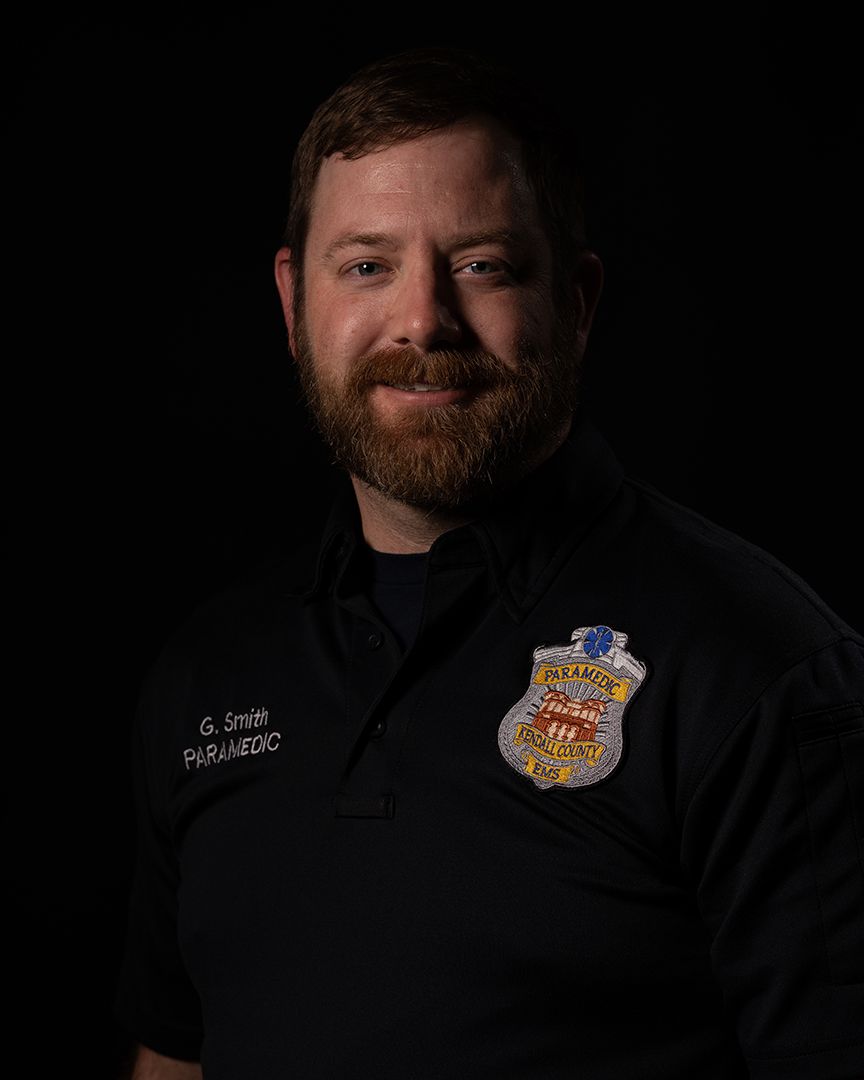
For Kendall County EMS paramedic Greg Smith, emergency medicine was not the original plan. Growing up in Castroville, Smith worked as an automotive technician before the economic downturn in the late 2000s pushed him to reconsider his path. A suggestion from a high school classmate led him to try EMT school in 2010, and what began as a practical decision quickly became something more meaningful.
“I did like the idea of helping people specifically in their time of need,” Smith said. “It’s great to just make contact with people. It may be that they’re just lonely and need someone to talk to. You just don’t know what they’re going through at their time of need that maybe I can help.”
More than a decade later, Smith now serves as a paramedic and field training officer with Kendall County EMS. The work requires technical skill, calm decision-making, and the ability to bring reassurance into moments that are often chaotic or frightening.
“Yeah, absolutely it is a passion,” Smith said. “We are not paid the best or the highest by any means, but the schedule works out.”
Many people outside the profession do not realize how advanced emergency medical care has become in the field. Smith says paramedics today operate far beyond the common perception of simply transporting patients to the hospital.
“A lot of people think of us just as a taxi or refer to us as ambulance drivers,” Smith said. “But that is clearly not the case because we are labeled a MICU, which is a mobile intensive care unit, and we can operate just as much as an ER and do everything we need to do to keep you alive to get you to the ER, including whole blood administration.”
That capability can make the difference during traumatic emergencies. Smith recalled one call involving a severe motorcycle crash where advanced treatment in the field helped keep a patient alive.
“We ended up getting on scene with him, putting a tourniquet,” Smith said. “Our chief dropped the whole blood off, and I gave him the whole blood in route to University Hospital.”
The patient required additional transfusions at the hospital but survived.
“When we got him to University Hospital, he ended up getting another 15 units of whole blood there to keep him alive,” Smith said. “He ended up, unfortunately, losing his leg, but he is still alive today.”
While dramatic rescues stand out, Smith says the most meaningful part of the job often comes from quieter interactions with the people responders meet every day.
“I would say the calls and the people that we encounter,” Smith said. “Them just being like, ‘Thank you for coming. My wife is not feeling well,’ or whatever the case is, and then getting a handshake at the end of the call. I genuinely hope that they get better after treating them.”
Serving in Kendall County adds another layer of meaning to the work. First responders often help the same neighbors they see at the grocery store, at church, or around town.
“I treat everybody like family,” Smith said. “I would want my grandmother to be treated the way that I treat people, and so I just carry that with me on all my calls.”
At the same time, the emotional weight of emergency medicine can be heavy. Responders regularly encounter loss and tragedy, and those experiences often stay with them long after the shift ends.
“You show up to some scenes that unfortunately people pass away, and you see their family members just heartbroken,” Smith said. “It reminds me to just be thankful for my family.”
Support from the community plays an important role in helping first responders carry that weight. Organizations like Hope for Heroes Texas bring responders together through regular gatherings and outreach while also providing resources that support first responders and their families.
“They do wonders here in this county,” Smith said. “The lunches that they put on once a month are great to get everybody together to eat. And they have a scholarship that my stepson applied for. It’s great in the sense that they’re there for us. They are very resourceful in what they have to offer first responders.”
For Smith, the work ultimately comes back to a simple idea: showing up when people need help most.
“If I can help you in your worst time, that’s just even more rewarding for me,” Smith said.
Brad Cornell, founder of Hope for Heroes Texas, says stories like Smith’s represent the quiet commitment of first responders across the Hill Country.
“The men and women who answer these calls carry burdens most people will never fully understand,” Cornell said. “Hope for Heroes Texas exists to make sure they know their community sees them, supports them, and is grateful for the work they do.”
From the April 2026 issue of The Kendall Gentleman.
From the Hope for Heroes series: For another Kendall County first responder devoted to emergency medicine, read about Dr. David Wampler. For a fellow Hero whose path to service took a long detour through another career, read about Officer David Chavez.