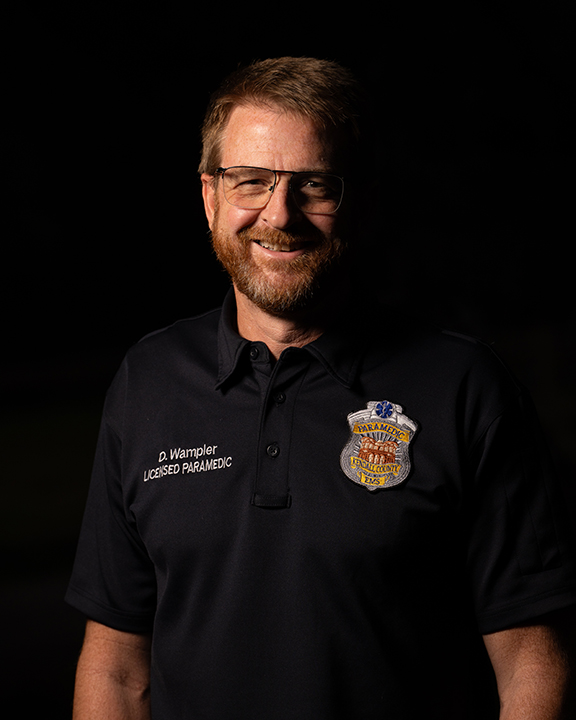
For Dr. David Wampler, the road to emergency medicine was never a straight one, but it is one he is grateful for every day. Raised in San Antonio, Wampler grew up loving the outdoors and serving others. As a Boy Scout, he developed an early fascination with first aid, lifesaving, and lifeguarding, skills that would one day save a man’s life. When a carpet installer at his home went into cardiac arrest, a teenage Wampler and a fellow Scout performed CPR until paramedics arrived. Against all odds, the man survived. That experience left a mark.
“I didn’t realize it then,” Wampler said, “but that was my first real introduction to what it meant to step into someone’s worst day and make it better.”
After high school, Wampler planned to pursue law enforcement until the final slot in the police academy filled moments before his turn. On a whim, he signed up for paramedic school instead. That decision would define the rest of his life.
Over the next decade, Wampler served as a firefighter and paramedic in Kerrville, balancing 24-hour shifts with college courses at nearby Schreiner University. He went on to earn a Ph.D. in Biochemistry, researching how light-dependent microbes could help break down environmental pollutants. His scientific curiosity and hands-on experience in the field would later merge into a passion for advancing prehospital medicine.
“I’ve always loved the sleuthiness of EMS,” he said with a grin. “You walk into a room, interpret what the patient is telling you, figure out what’s wrong, and come up with a plan to make it better.”
Today, Wampler serves as the Director of Clinical Research for the Office of the Medical Director at UT Health San Antonio, where he helps shape evidence-based policies for emergency medical care across the region. Yet, despite his academic credentials and leadership roles, he has continued to serve for nearly 18 years as a part-time paramedic with Kendall County EMS, keeping his boots on the ground and his heart close to the work that first inspired him. Locals will often spot him on the sidelines of Champion High School Charger football games, quietly standing by to provide emergency medical support when needed.
“I live here. My family lives here. My kids went to school here,” he explained. “Working shifts as a field paramedic lets me stay connected to my community and to the realities of patient care. I may not hold a formal leadership role in Kendall County EMS, but I want to lead by example and
model professionalism and compassionate care for those coming up behind me.”
For Wampler, adrenaline may have drawn him into EMS, but compassion is what has kept him in it. “I still get nervous when the tones go off,” he admitted. “That feeling never really goes away. But every call is a chance to do something meaningful. The science keeps me sharp, but empathy keeps me alive.”
Hope For Heroes Texas
Though his schedule often keeps him in San Antonio, Wampler has watched the impact of Hope For Heroes Texas ripple through the Kendall County first responder community.
“Many of my colleagues have attended and have had nothing but great things to say,” he said. “The fellowship and collaboration Hope For Heroes Texas creates away from the stress of scene calls and training is invaluable.”
For Wampler, that kind of community matters deeply.
“I have a PhD in Biochemistry. I am a professor in an elite medical university. I have been a paramedic for almost 35 years — I am a pretty smart guy,” he said. “But I only bring one perspective into the room. The room will have a much more robust perspective than any one person. The room is always smarter than any one person. That is the importance of getting a multidisciplinary room together. All the first responders, police, fire, EMS, infrastructure, business leaders, community leaders, and spiritual leaders bring a collaboration that will move public safety forward.”
He sees Hope For Heroes Texas as a catalyst for that kind of strength, a place where first responders can connect, learn from one another, and be reminded they are part of something larger than themselves.
“We’re at our best when we serve together,” Wampler reflected. “Programs like this bring those strengths into one room, and that room is what moves public safety forward. Low-stress camaraderie builds resilience for high-stress situations.”
Message from Brad Cornell
Brad Cornell, founder of Hope For Heroes Texas, sees leaders like Dr. Wampler as vital to the mission.
“Supporting first responders isn’t just about providing meals or saying thank you,” Cornell said. “It’s about investing in people like Dr. Wampler who dedicate their lives to saving others, pushing science forward, and mentoring the next generation. He reminds us that service comes in many forms, through action, through teaching, and through heart. That is what Hope For Heroes Texas is all about.”
From the November 2025 issue of The Kendall Gentleman.
From the Hope for Heroes series: For another Kendall County first responder devoted to emergency medicine, read about paramedic Greg Smith. For a fellow Hero who came to his calling by an unexpected road, read about Officer David Chavez.