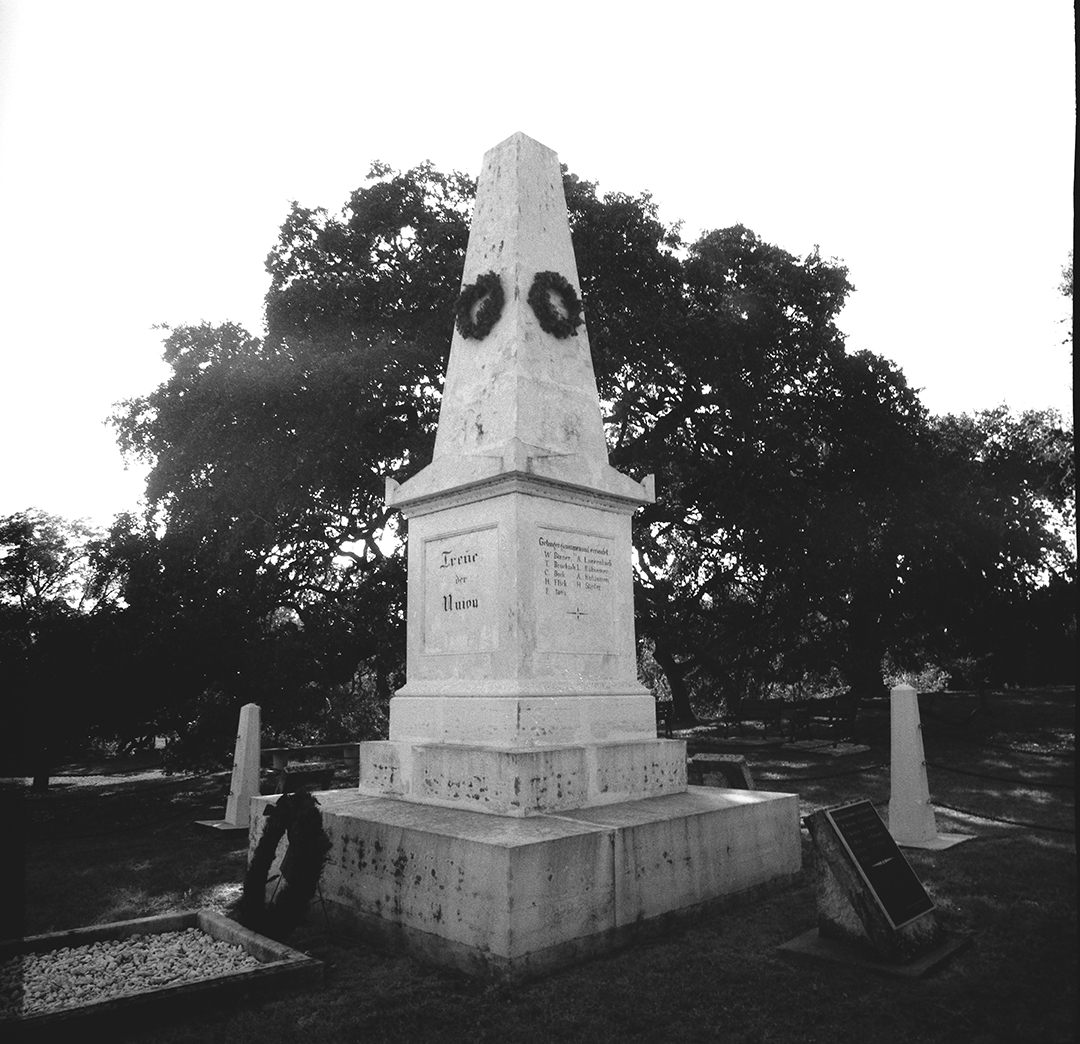
Comfort’s Enduring Tribute to the German-Texan Unionists of 1862
In the heart of Comfort, Texas, shaded by ancient live oaks and surrounded by the quiet hum of Hill Country life, stands a monument unlike any other in the American South. Modest in size but immense in meaning, the Treue der Union Monument has watched over the community for more than 150 years. Its limestone shaft rises from the earth not as a symbol of victory or conquest, but as a testament to loyalty, sacrifice, and the courage to follow one’s conscience in a time of national turmoil.
For residents of Kendall County and the surrounding Hill Country, the monument is more than a historical marker. It is a reminder of the region’s unique heritage — a heritage shaped by German immigrants who brought with them a fierce devotion to liberty, education, and democratic ideals. The story of the Treue der Union Monument is, in many ways, the story of the Hill Country itself.
A Monument Born of Tragedy
The monument commemorates the 36 German-Texan Unionists who died in 1862 during and after the Battle of the Nueces, a violent clash between Confederate forces and a group of Hill Country Germans attempting to flee to Mexico. These men — many of them young, many of them recent immigrants — refused to swear allegiance to the Confederacy. Their decision was rooted in deeply held beliefs about freedom, human rights, and the role of government.
When Confederate authorities imposed conscription, these German settlers faced an impossible choice: fight for a cause they opposed, or risk their lives by resisting. A group of roughly sixty men chose the latter, setting out for Mexico in hopes of eventually joining Union forces. They never made it. Confederate troops attacked their camp along the Nueces River on August 10, 1862. The battle was brief and brutal. Many Germans were killed outright; others were executed after surrendering.
The tragedy sent shockwaves through the Hill Country’s German communities. Families mourned sons, brothers, and husbands. The loss deepened the cultural and political divide between the German settlers and the Confederate authorities. Yet even in grief, the community found a way to honor the fallen.
A Monument Unlike Any Other
In 1866, just one year after the Civil War ended, the people of Comfort erected a monument to the men who had died at the Nueces. They named it Treue der Union, a German phrase meaning “Loyalty to the Union.” The monument stands today as one of the only Union memorials located on former Confederate soil, and it remains a powerful symbol of the German-Texan commitment to principle over pressure.
Constructed of native limestone, the monument is simple and unadorned — a reflection of the community that built it. Its clean lines and modest height belie the depth of emotion and meaning it carries. At its base lies a communal grave containing the remains of many of the men who died at the Nueces. Their names are inscribed on the monument’s face, including:
- Ernst Beseler
- Hermann Lange
- Friedrich Schubert
- Wilhelm Luckenbach
- August Hoffman
- Hugo and Hilmar Degener
- And many others whose stories echo through Hill Country history
The monument was dedicated on August 10, 1866 — exactly four years after the battle — in a ceremony attended by grieving families, community leaders, and fellow Unionists. It has stood ever since as a quiet but resolute reminder of the cost of conscience.
Why the Monument Matters
The Treue der Union Monument is significant for several reasons, each of which speaks to the character of the Hill Country’s early settlers.
- It Honors Moral Courage
The men commemorated here did not die in pursuit of power or territory. They died because they refused to compromise their beliefs. Their story challenges the simplistic narratives often told about Texas during the Civil War and highlights the diversity of thought among its people.
- It Reflects the German-Texan Legacy
The Hill Country’s German settlers brought with them a strong tradition of intellectual independence, secular governance, and democratic ideals. The monument stands as a physical embodiment of those values.
- It Preserves a Unique Chapter of Texas History
Few places in the South openly memorialized Union loyalty after the Civil War. Comfort’s decision to do so — and to do so in German — speaks volumes about the community’s identity and resilience.
- It Serves as a Place of Reflection
Visitors often remark on the monument’s quiet dignity. It invites contemplation, not celebration. It asks us to consider the cost of standing by one’s principles and the importance of remembering those who did.
The Monument Through the Years
Over the decades, the Treue der Union Monument has become a cherished landmark. It has survived storms, political shifts, and the passage of time. Local organizations, including historical societies and descendants’ groups, have worked to preserve it and educate the public about its significance.
Annual commemorations continue to honor the men who died at the Nueces. These gatherings are not political events; they are acts of remembrance. They celebrate the courage of individuals who chose integrity over safety and who paid the ultimate price for their convictions.
The monument has also drawn the attention of historians, scholars, and visitors from around the world. Its presence challenges assumptions about Texas history and highlights the complexity of the Civil War era in the American West.
A Hill Country Story of Conscience
The Treue der Union Monument is more than a stone obelisk. It is a story — a story of young men who believed in freedom, of families who refused to let their sacrifice be forgotten, and of a community that chose to honor principle even when it was unpopular.
For Kendall County residents, the monument is a reminder that the Hill Country’s history is rich, layered, and deeply human. It tells us that our ancestors were not monolithic in their beliefs. They were thinkers, dreamers, and idealists. They were people who valued education, debate, and moral clarity. And they were willing to stand up for those values, even when doing so put them in harm’s way.
A Legacy That Lives On
Today, the Treue der Union Monument remains one of the most meaningful historical sites in the Hill Country. It stands as a testament to the German-Texan spirit — independent, principled, and unafraid to chart its own course.
For those who pause to read the names etched into its limestone surface, the monument offers a moment of connection across time. It invites us to remember not only the men who died at the Nueces, but also the ideals they carried with them: liberty, conscience, and the belief that doing what is right is worth the risk.
In honoring them, we honor the very foundations of the Hill Country’s identity.
From the April 2026 issue of The Kendall Gentleman.
From the Hill Country archive: Three of the young men whose names are carved into the monument have their stories told in full at The Kendall Gentleman: Ernst Beseler (1841–1862), Hermann Lange (1844–1862), and August Hoffman (1843–1862).