In the quiet folds of the Texas Hill Country, where limestone bluffs rise above clear creeks, and the breeze carries the scent of cedar and wild grass, history often hides in plain sight. It lingers in the names of old families, in the weathered stones of pioneer cemeteries, and in the stories passed down through generations. Among these stories is the life of Ernst Beseler, a young German immigrant whose brief time in Kendall County left a mark far deeper than his twenty-one years might suggest.
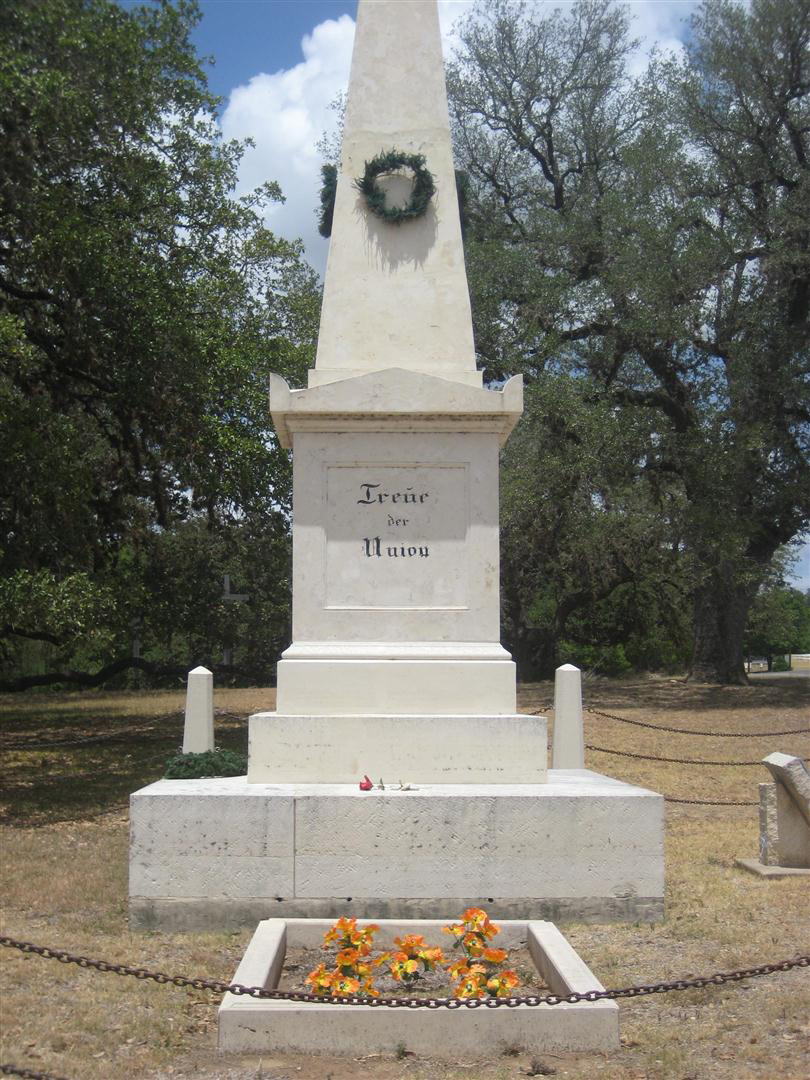
Today, his name is carved into the Treue der Union Monument in Comfort – a solemn reminder of the German settlers who chose loyalty to conscience over loyalty to the Confederacy during the Civil War. For many in Kendall County, the monument is familiar. But the young man behind one of those engraved names deserves his own remembrance. His story is not only one of tragedy, but also of courage, conviction, and the enduring spirit of the Hill Country’s earliest settlers.
This is the story of Ernst Beseler (1841–1862) – a pioneer whose legacy continues to echo across Kendall County.
- A New Life in a New Land
The mid-19th century brought waves of German immigrants to Texas, many of them fleeing political upheaval, economic hardship, or the rigid social structures of the old German states. They arrived with dreams of land, freedom, and opportunity. Among them was the Beseler family, who settled in the region that would later become Kendall County.
Ernst was born in 1841 in Germany, likely in one of the northern provinces that sent so many settlers to Texas. He was still a child when his family crossed the Atlantic, joining thousands of others who made the long, uncertain journey to the New World. For families like the Beselers, Texas offered something rare in Europe: the promise of land ownership and the chance to build a community shaped by their own values.
The Hill Country they encountered was rugged, beautiful, and demanding. The land required hard work, but it rewarded perseverance. German settlers carved farms out of the rocky soil, built mills along the creeks, and established small but vibrant communities – places like Boerne, Comfort, Sisterdale, and Welfare. These settlements quickly became known for their industriousness, their music and festivals, and their strong commitment to education and civic life.
Young Ernst grew up in this environment. He would have learned to ride, hunt, and farm alongside other boys of the Hill Country. He would have spoken German at home and English in the growing towns. And he would have absorbed the values that defined the German-Texan communities: independence, reason, and a deep belief in personal liberty.
These values would later shape the most consequential decision of his life.
- The German Freethinker Tradition
To understand Ernst Beseler’s story, one must understand the unique political and cultural climate of the Hill Country’s German settlements. Many of the early immigrants were Freethinkers – intellectuals, craftsmen, and political refugees who had participated in or supported the failed democratic revolutions of 1848 in Europe. They brought with them a strong commitment to:
- Individual liberty
- Secular government
- Opposition to slavery
- Freedom of speech and thought
Communities like Sisterdale and Comfort became centers of this Freethinker movement. They established debating societies, reading clubs, and schools that emphasized reason and civic responsibility. They were, in many ways, ahead of their time – advocating for ideals that would not become mainstream in America for decades.
When the Civil War erupted in 1861, these German communities found themselves at odds with the Confederate government. Many refused to support secession. Many opposed slavery. And many refused to take up arms for a cause they believed violated the principles of liberty and human dignity.
Ernst Beseler was among them.
- A Difficult Choice in a Dangerous Time
By 1862, the Confederate government had imposed mandatory military service on all able-bodied men. For German settlers who opposed the Confederacy, this created a moral crisis. They could not, in good conscience, fight for a cause they believed was unjust. Yet refusing to serve carried severe consequences – imprisonment, confiscation of property, or worse.
In the summer of 1862, a group of approximately sixty German Unionists from the Hill Country made a fateful decision. They would flee to Mexico, where they hoped to avoid conscription and eventually join Union forces. Their plan was simple but perilous: travel south through the rugged brush country, cross the Rio Grande, and make their way to the safety of Union-controlled territory.
Among the young men who joined this group was Ernst Beseler, just twenty-one years old.
He was not alone. Many of the men were his neighbors, friends, or relatives. They shared the same values, the same fears, and the same determination to remain true to their principles.
Their journey would become one of the most tragic episodes in Texas history.
- The Battle of the Nueces
On August 10, 1862, as the group camped along the Nueces River, Confederate forces launched a surprise attack. What followed is known today as the Battle of the Nueces, though many historians argue that “battle” is too generous a term. The German Unionists were outnumbered, outgunned, and caught off guard.
The fighting was fierce but brief. Many of the Germans were killed in the initial assault. Others were wounded and later executed by Confederate soldiers. A few managed to escape into the brush and eventually reach Mexico, but the majority did not survive.
Among the dead was Ernst Beseler.
He died far from home, in a remote stretch of South Texas, fighting not for conquest or glory but for the right to follow his conscience. His death, like those of his companions, sent shockwaves through the Hill Country’s German communities. Families mourned sons, brothers, and husbands. The tragedy deepened the divide between the German settlers and the Confederate authorities.
Yet even in grief, the community found a way to honor their fallen.
- Treue der Union: A Monument to Principle
In 1866, after the war had ended, the people of Comfort erected a monument unlike any other in the former Confederacy. They called it Treue der Union – “Loyalty to the Union.” It stands today in the center of Comfort, a simple limestone obelisk bearing the names of the men who died at the Nueces.
Among those names is Ernst Beseler.
The monument is remarkable not only for its purpose but also for its location. It is one of the only Union monuments on Confederate soil, and it remains a powerful symbol of the German-Texan commitment to principle over pressure.
For many families in Kendall County, the monument is a place of remembrance. For historians, it is a testament to the complexity of Texas’s Civil War experience. And for those who study the lives of early settlers, it is a reminder that the Hill Country’s history is not defined solely by cattle drives and frontier hardships, but also by moral courage and political conviction.
- A Life Cut Short, A Legacy That Endures
Ernst Beseler did not live long enough to build a ranch, raise a family, or become one of the civic leaders whose names fill the early records of Kendall County. He left behind no business, no homestead, no descendants to carry on his name.
Yet his legacy is no less significant.
He represents the young men whose lives were shaped – and in many cases cut short – by the turbulent forces of history. He represents the German settlers who brought new ideas and values to the Hill Country. And he represents the courage it took to stand by one’s beliefs in a time when doing so could cost everything.
In many ways, Ernst’s story is the story of the Hill Country itself: a story of immigrants seeking freedom, of communities built on shared ideals, and of individuals who chose integrity over safety.
- The Beseler Family in Kendall County
Though Ernst himself left no descendants, the Beseler family continued to play an important role in the development of the region. Other members of the family became ranchers, merchants, and civic leaders in the communities of Welfare, Comfort, and Boerne.
Their contributions helped shape the economic and cultural landscape of Kendall County. The family’s presence in the area serves as a reminder that the story of one young man is part of a much larger tapestry – a tapestry woven from the lives of hundreds of German settlers who built the Hill Country into the place we know today.
- Why Ernst Beseler Matters Today
In a world that often celebrates the loudest voices and the most dramatic victories, the story of Ernst Beseler offers a different kind of inspiration. His life reminds us that courage is not always found on the battlefield or in the halls of power. Sometimes it is found in the quiet resolve of a young man who chooses to follow his conscience, even when the cost is high.
For the people of Kendall County, remembering Ernst is a way of honoring the values that shaped this region:
- Integrity
- Community
- Commitment to principle
- Respect for individual liberty
These values continue to define the Hill Country today, just as they did in the 1850s and 1860s.
- A Place in Hill Country Memory
Walk through Comfort on a quiet morning, and you may hear the distant echo of history in the rustle of the cypress trees or the creak of an old porch. Visit the Treue der Union Monument, and you will find Ernst’s name among those who gave their lives for a cause they believed in.
His story is not one of triumph in the traditional sense. It is a story of conviction, sacrifice, and the enduring power of principle. It is a story that deserves to be told – and retold – in the pages of Kendall County’s history.
As we honor the pioneers who built the Hill Country, let us also honor those like Ernst Beseler, whose courage helped shape the character of this remarkable place. His life may have been short, but his legacy continues to remind us that the strength of a community lies not only in its buildings and businesses, but in the values of the people who call it home.
From the March 2026 issue of The Kendall Gentleman.
From the Hill Country archive: Beseler’s name is carved into the Treue der Union Monument in Comfort. Read about another young Hill Country Unionist remembered on the same stone: Hermann Lange.