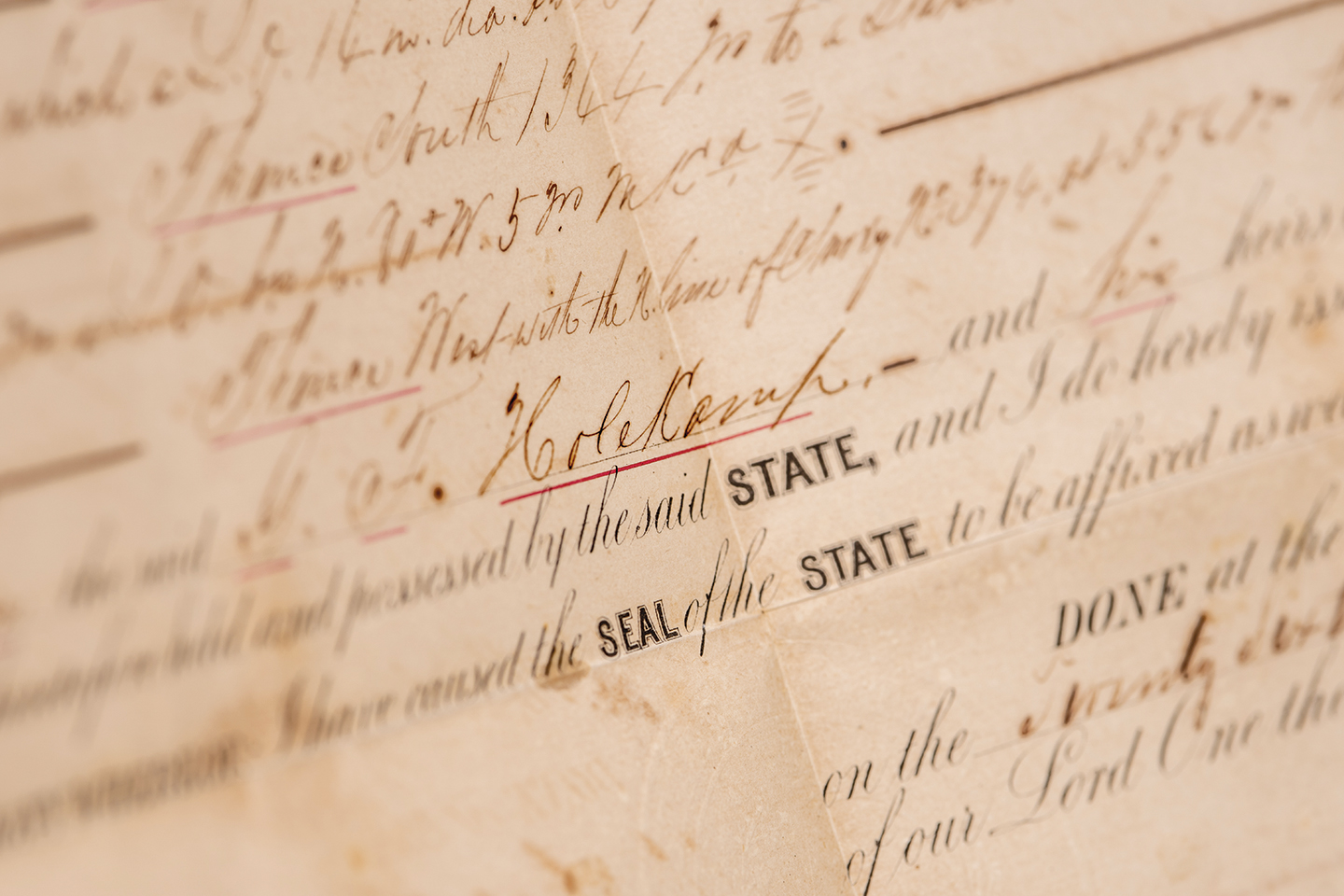
When Friedrich “Fritz” Holekamp and his young wife, Betty, left Germany in 1844, Kendall County did not exist. Boerne had not been founded, Comfort had not been surveyed, and Sisterdale was still several years in the future.
Yet the Holekamp family would eventually become woven into the history of all three communities. Their story is particularly fitting among the founding families of Kendall County because their influence did not end with the pioneer generation. Their descendants became businessmen, teachers, county officials, bankers, musicians, civic leaders and even a member of the Texas Legislature.
From Hannover to the Texas Frontier
Betty Wilhelmine Abbenthern was born March 4, 1826, in the Kingdom of Hannover. On March 17, 1844, at eighteen, she married Georg Friedrich “Fritz” Holekamp, born in Hannover in 1812.
Within months, the newlyweds made an extraordinary decision: they would leave Germany for Texas.
They joined the German immigration movement associated with the Adelsverein, the Society for the Protection of German Immigrants in Texas. In September 1844, Fritz and Betty sailed from Bremerhaven aboard the Johann Dethardt, reaching Galveston that November.
Betty was only eighteen years old when she exchanged the relative comforts of Germany for the Texas frontier.
The Holekamps first participated in the settlement of New Braunfels, where Fritz established a mill on the Comal River. They later lived in Fredericksburg, and Fritz signed an 1847 petition seeking the creation of Gillespie County.
Their journey eventually brought them to Sisterdale.
There, on June 10, 1849, Betty gave birth to their son Julius. He has traditionally been described as the first white child born in Kendall County. More precisely, Julius was born within the territory that later became Kendall County, which was not formally created until 1862.
Helping Build Comfort
The family moved again before settling at Comfort in 1854, just as that new German community was being established.
Fritz participated in surveying and platting the town, and historical accounts credit the Holekamps with building Comfort’s first house.
That statement is worth considering. The Holekamps did not arrive in an established town. Streets, businesses, and homes familiar to later generations were only beginning to take shape. They were there while a settlement was literally becoming a community.
By this time Fritz and Betty were raising what eventually became a family of seven children: George, Julius, Daniel, Dora, Johanna, Ernest, and Bettie.
Then the Civil War changed everything.
Fritz joined the company of Captain John Herman Kampmann and was stationed at Brownsville. He died in 1862.
Betty was approximately thirty-six years old and suddenly responsible for seven children.
She never remarried.
Instead, historical accounts tell us that she took in boarders and operated washing and sewing businesses to support her family.
Some colorful traditions surround Betty Holekamp. One says she boldly rode through a swollen Guadalupe River during the immigrants’ journey. Another says that when Texas became part of the United States, she fashioned an American flag with a single star and consequently became known as the “Betsy Ross of Texas.”
Those stories are part of Holekamp family and Hill Country tradition, although they cannot be documented as confidently as other parts of her life.
The documented story may be more impressive.
A thirty-six-year-old widow on the Texas frontier managed to keep seven children together and provide for them through her own labor.
Betty remained in Comfort for another forty years. She died November 2, 1902.
But by then the Holekamp story had moved into another generation.
From Pioneers to Community Builders
Fritz and Betty’s children became participants in the economic and civic life of the communities their parents’ generation had helped establish.
Their son Daniel, known as Dan, became a Comfort businessman. Dan and his wife, Franciska “Frances” Wiedenfeld Holekamp, operated several enterprises beginning in the 1880s, including a mercantile business and an establishment known as Holekamp’s Hall.
The hall served as more than a business. Concerts and other entertainment were held there, including German-language performances, making it part of Comfort’s social and cultural life.
Today, the Dan and Frances Holekamp home at 421 Seventh Street in Comfort is recognized with an Official Texas Historical Marker.
Julius – the son born at Sisterdale in 1849 – also entered public service, becoming a Kendall County commissioner representing the Comfort precinct.
The family’s movement from pioneer settlement into public service would continue with his sons.
A Holekamp Helps Build Boerne
Julius’s son Paul Fricke Holekamp, born in Comfort in 1877, became one of the family’s most significant figures in Boerne.
Paul began as a teacher before voters elected him Kendall County tax assessor in 1904. He would serve the county in that position for more than thirty years.
His activities extended far beyond the courthouse.
When Boerne State Bank was organized in 1906, Paul served as assistant cashier. He later became involved in preparing abstracts of title and helped develop the business that became Kendall County Abstract Company. He also served as secretary of the Kendall County Fair Association.
And there was music.
In 1906, Paul became director of the Boerne Gesang Verein, the German singing society. He remained its director for more than half a century.
The connection between generations is striking. Fritz Holekamp had studied music in Germany. Decades later, his grandson was helping preserve German musical traditions in Boerne.
From Immigrant Family to the Texas Capitol
Paul’s younger brother, Bodo Julius Holekamp, carried the family tradition of public service even farther.
Born in Comfort in 1878, Bodo became active in business, church and German cultural organizations before entering politics.
In 1932, voters elected him to the Texas House of Representatives.
Bodo represented Blanco, Gillespie, Kendall and Llano counties during the 43rd Legislature from 1933 to 1935. Legislative records identify him as an Independent – a notable distinction in Texas politics of that era.
Consider what had happened in less than ninety years.
In 1844, eighteen-year-old Betty Holekamp stepped aboard a ship in Germany with her new husband, headed toward a frontier she had never seen.
By 1933, their grandson was sitting in the Texas Capitol representing Kendall County.
A Family Becomes Part of a County
That progression explains why the Holekamps deserve to be remembered among Kendall County’s important families.
One generation helped establish settlements.
The next created businesses and assumed responsibilities within those communities.
The grandchildren became teachers, county officials, bankers, businessmen, cultural leaders and elected representatives.
Their influence touched Comfort, Sisterdale and Boerne – and institutions ranging from county government and banking to education, land records, music and the Kendall County Fair.
The Holekamp story also reminds us that communities are rarely built by one celebrated founder.
They are built over generations.
“The Holekamp story also reminds us that communities are rarely built by one celebrated founder. They are built over generations.”
They are built by immigrants willing to risk everything on a new beginning; by people who survey land and construct the first houses; by widows who somehow hold families together; by merchants who establish businesses; by teachers who educate children; and by citizens willing to serve their neighbors.
Fritz Holekamp did not live long enough to see what his family’s decision to come to Texas ultimately produced.
Betty did.
For forty years after her husband’s death, she watched her children become adults, settlements become towns, and the Texas frontier become home.
The Holekamps came to Texas looking for a new life.
In the process, they helped build the communities that became Kendall County.
From the October 2026 issue of The Kendall Gentleman.
The Holekamps’ roots in Sisterdale connect to Ernst Kapp and the Extraordinary Community of Sisterdale and Nicolaus Zink: A Pioneer of Kendall County Texas, and to this issue’s cover story on Wes Holekamp, The Long Road Home. Readers may also enjoy Men of the Hill Country: Kendall County’s Legacy in America’s 250-Year Story.