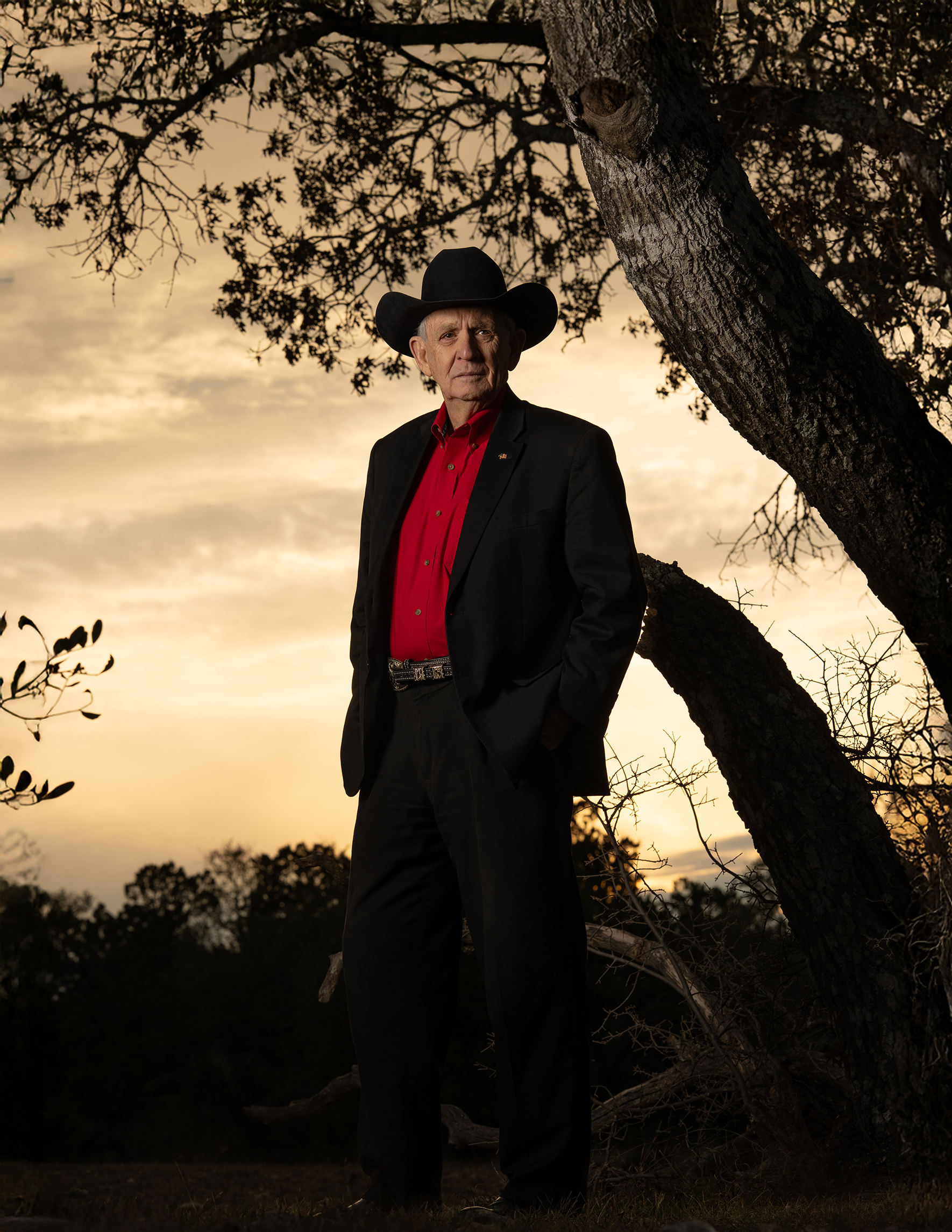
I first met General Leroy Sisco several years ago at a campaign event for Quico Canseco. It was one of those introductions that happens in passing. A handshake. A few words. A sense that the man in front of you carries gravity, even if you don’t yet know why. The room was loud, the night moved on, and life did what it always does.
I knew who he was. I knew of his service. I knew about the Military Warriors Support Foundation. And like a lot of people, I admired him from a respectful distance.
It wasn’t until years later, when Leroy stepped into the orbit of Dorman Vick, that I really began to understand the man. Watching him engage with Dorman, advocate for vocational education, and quietly use his influence to support a teacher who pours his life into young men and women told me more than any résumé ever could. That was the moment admiration turned into something deeper. Respect.
Over the last couple of years, getting to know Leroy personally has been genuinely rewarding. Not because he’s impressive, though he is. But because he’s consistent. The public figure and the private man are the same.
When we sat down for our interview, there was no agenda. No performance. Just a steady, measured voice shaped by decades of leadership and responsibility. Early on, he said something that framed everything that followed.
“I’ve been blessed my whole life,” he told me. “And I’ve always believed when you’ve been given much, you’re obligated to give much back.”
That sentence explains Leroy Sisco better than any rank or title ever could.
His story begins far from stadium stages and boardrooms. He was born in Oklahoma and raised in a working family. His father died young, at just forty-three, leaving his mother to raise three boys on a teacher’s salary. It was the kind of loss that forces maturity early.
“I went to work when I was fourteen,” he said. “There wasn’t any other option.”
The family eventually moved to Abilene, Texas. Life there came with expectations. You showed up. You worked. You carried your weight. Leroy still speaks with gratitude about Don Whitaker, a World War II combat veteran who managed a retail store where Leroy worked as a teenager. When he quit working at T.G.&Y. to attend college, Sam Walton hired Don Whitaker to run Walton’s Five & Dime, and eventually, he was Walmart’s first store manager.
“He taught me how to show up. How to take responsibility. How to respect people,” Leroy said. “That stuck with me.”
Those lessons carried him into the Texas National Guard while he was still in high school. He didn’t join out of drama or ambition. He joined because it felt right. He worked his way through Abilene Christian University over five years while holding a full-time job. Nothing about his early life was fast. Everything about it was earned.
That pattern never changed.
Leroy served forty-two years in uniform, rising from enlisted service to Lieutenant General. Along the way, he qualified in five Army branches: infantry, engineer, quartermaster, logistics, and armor. That breadth mattered. It made him useful in ways that weren’t always obvious at the time.
He commanded at every level. Platoon. Company. Battalion. Brigade. General officer. One of the pivotal moments came during large-scale REFORGER operations in Germany, where he was responsible for moving enormous amounts of troops and equipment across Europe. His unit dramatically outperformed higher-ranked commands.
“I didn’t realize it at the time,” he told me with a small smile, “but that assignment changed everything.”
Promotion to general officer wasn’t assumed. Leroy was selected because of something harder to quantify than seniority. Competence across disciplines. Calm under pressure. And the trust of those above him.
Yet when he talks about his military career, he rarely leads with rank or accolades.
“The honor was serving with good people,” he said. “That’s what stays with you.”
What many don’t realize is how essential Leroy’s civilian career became to what followed. He spent decades with NCR Corporation, rising from sales to district management and eventually leading a multi-state financial division. Later, he co-founded and scaled a private company serving financial institutions.
“I learned how banks think,” he said. “How loans really work. How assets are evaluated.”
At the time, it was just business; in hindsight, it was preparation.
The Military Warriors Support Foundation was not born from a nonprofit blueprint. It came from frustration. Leroy watched wounded veterans return home carrying physical injuries, invisible wounds, and crushing financial pressure.
“We tell them thank you,” he said. “And then we expect them to figure everything else out.”
His solution was radical in its simplicity. Remove the mortgage. Remove the payment. Remove the pressure.
Homes, given outright.
Not raffled. Not discounted. Given.
Since its founding, the Military Warriors Support Foundation has awarded nearly twelve hundred mortgage-free homes, hundreds of vehicles, and facilitated hundreds of restorative outdoor trips each year. The total charitable value approaches half a billion dollars. Experts estimate the work has directly saved more than 160 veteran lives.
Those numbers matter. But Leroy never leads with them.
“This isn’t charity,” he told me. “It’s stability.”
What sets the foundation apart is discipline. Homes aren’t immediately deeded. For three years, recipients complete mandatory financial education taught by retired bankers and CPAs. The result is extraordinary. More than 98 percent of recipients are debt-free when the title is finally transferred.
“A gift without wisdom can become a burden,” Leroy said. “We didn’t want to create another problem while solving one.”
At times, the work became very public. Through a long-standing partnership with George Strait, they’ve given 127 homes away together over the last 15 years. Leroy tells me, “There are not enough words to thank George for his incredible support”. He has found himself standing on stages in front of tens of thousands of people, handing keys to wounded veterans. Two of the most unforgettable moments came at AT&T Stadium, in front of 106,000 fans, and at Texas A&M University in front of 110,905 fans, handing keys to incredible heroes.
No script. No spectacle. Just a family realizing their future had changed forever.
“Those moments aren’t about the crowd,” Leroy said. “They’re about accountability. When you honor someone publicly, you remind the country what honor actually looks like.”
National media took notice. Appearances on the Today Show twice, followed by the Mike Huckabee Show multiple times. Headlines came and went. The cameras eventually moved on.
The counseling never did.
In recent years, Leroy took on another fight that mattered deeply to him. One that had nothing to do with houses or vehicles, and everything to do with honor.
For decades, Medal of Honor recipients received a modest monthly stipend from the federal government. Modest to the point of embarrassment. Leroy knew that number. He’d known it for years. And it bothered him.
“These men did things the rest of us can’t even imagine,” he told me. “And we were paying them like it was an afterthought.”
What followed was a sustained, behind-the-scenes effort that took patience, relationships, and persistence. Leroy worked closely with Congressman Troy Nehls, Senator Ted Cruz, and ultimately President Donald Trump to push legislation that would meaningfully raise the monthly pension for Medal of Honor recipients.
It wasn’t flashy work. It was phone calls. Meetings. Education. Relentless follow-up. The kind of work Leroy has always been comfortable doing.
When the legislation was finally passed and signed into law, the increase was significant – $5,780.36 per month, tax-free. Life-changing, in some cases. And for Leroy, it was deeply personal.
“I’m proud of that,” he said, without hesitation. “Those men earned it. Every single bit of it.” The legislation nearly quadrupled the stipend for these heroes to around $69,364.32 annually – every penny of it tax-free. He said it was a true honor to be in President Trump’s office when he signed the bill. After the President signed the bill, he gave the pen to General Sisco. Leroy admitted it was a bit emotional.
There was no self-congratulation in his voice. Just relief that the system had finally done right by men who had given everything.
Leroy’s sense of duty doesn’t stop with veterans. His advocacy for vocational education runs just as deep. He believes skilled trades offer dignity, independence, and purpose, and he’s put real resources behind that belief.
“We’ve told too many kids that success only looks one way,” he said. “That’s just not true. Some of the most successful, fulfilled people I know work with their hands.”
That conviction is what led him to Dorman Vick, and it’s why watching that relationship unfold changed how I saw him. Leroy didn’t posture. He didn’t make announcements. He showed up. Quietly. Consistently. With results.
Faith runs through Leroy’s life without showmanship. Married for fifty-nine years, he met his wife, Frances, at Abilene Christian University. He tells everyone, “She is an Angel on earth and the best thing that has ever happened to me.” Together, they raised three children, one of whom they lost – their daughter. They now enjoy two sons, two daughters-in-law, and five grandchildren.
“I’ve been carried more times than I can count,” he told me. “By my wife. By God. By people who showed up when it mattered.”
That sense of being carried seems to fuel his insistence on carrying others. Not out of guilt. Out of gratitude.
Kendall County understands men like Leroy Sisco.
Men who build.
Men who serve.
Men who don’t confuse recognition with responsibility.
I’ve known of Leroy for years. I’ve looked up to him for a long time. But getting to know him personally these past couple of years has been something else entirely. It’s shown me what steady leadership looks like when the spotlight fades.
Some men stop serving when the uniform comes off.
Leroy never did.
Some men chase legacy. Others live it without ever naming it.
Leroy Sisco has spent a lifetime carrying responsibility quietly. For his family. For his soldiers. For wounded veterans who needed more than applause. For Medal of Honor recipients who deserved better than an afterthought. For young men and women learning a trade who just needed someone to believe in the work of their hands.
He never waited for permission. He never asked for credit. He simply showed up, again and again, and did what needed to be done.
And for that, General Leroy Sisco is The Kendall Gentleman.
Key Facts
- Full name: Leroy Sisco
- Born: Oklahoma
- Roles: Lieutenant General, 42 years in uniform; founder of the Military Warriors Support Foundation; vocational education advocate; former NCR Corporation division leader
- Issue: February 2026
From the February 2026 issue of The Kendall Gentleman.
More from The Kendall Gentleman: for more on the men who wore the uniform and kept serving long after, read Those Who Served. And for another story of a life built entirely around service to others, The Legacy of Service: Collins Martin covers the same territory.