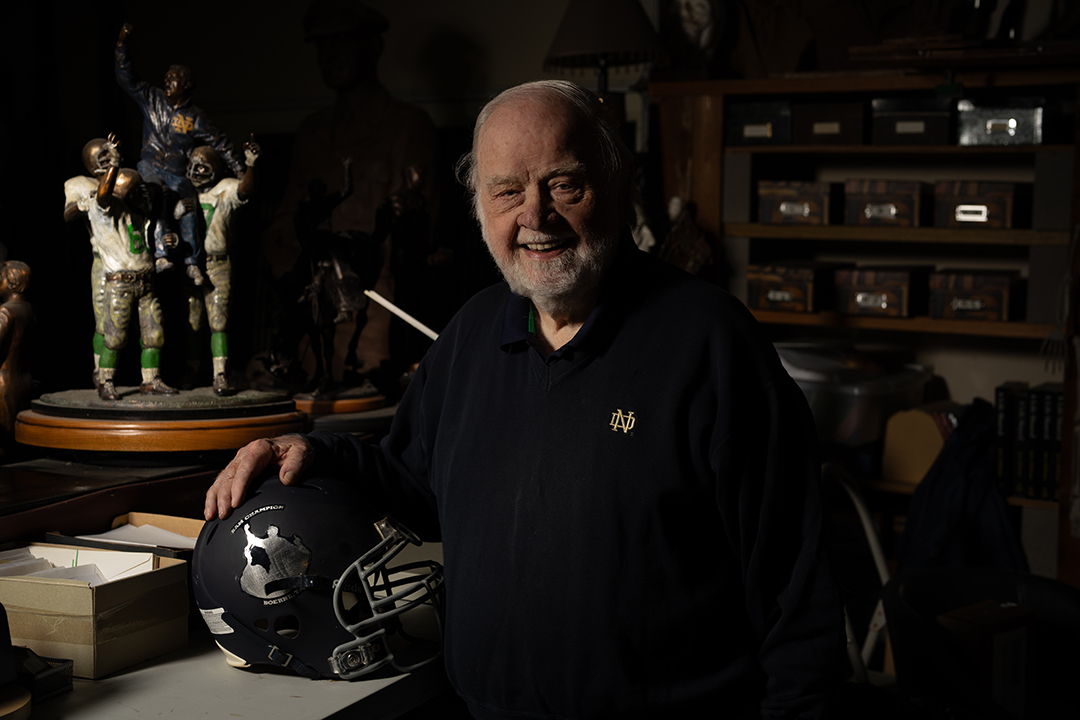
When you sit with Jerry McKenna, time slows down in the best way. The man has lived enough for three lifetimes, and he talks about each one with a steadiness that comes from earned peace. His voice is gentle, his memory sharp, and his stories roll out one after another with the calm of someone who has learned not to rush anything that matters.
On the table beside him are a few familiar faces cast in plaster. Clay tools rest where he left them. He will never use them again. After more than forty years of sculpting, Jerry recently put them down for the last time. His vision is weakening, his back fights him, and he knows enough to quit while his work still honors the people he sculpted.
“I’ve had a long run,” he says quietly. “Longer than I ever expected.”
It’s an honest reflection from a man who never thought he would amount to much, yet somehow ended up shaping the memories of universities, saints, veterans, and national heroes. His hands captured more American history in clay than most textbooks.
But before he became one of the most respected portrait sculptors in the country, he lived a childhood that looked nothing like the life he eventually built.
The First Life
Jerry was born in Connellsville, Pennsylvania, and moved six weeks later. That became the pattern. His father’s work as a construction engineer meant the family chased project after project. New towns. New schools. New challenges. By the time he finished high school, he’d attended twenty schools and lived in everything from trailers to borrowed rooms.
He struggled in classrooms and carried the kind of self-doubt that sinks deep when you’re young. He never saw himself as gifted. Never saw himself as destined for anything special. But he paid attention to people. “Faces always interested me,” he says. “I didn’t know why.”
He would later learn that God sometimes plants seeds long before a man is old enough to recognize what he’s carrying.
The Notre Dame Years
Notre Dame was the dream that stuck. He made it there against the odds and studied art under mentors who taught him the fundamentals he would rediscover later in life. He even entered the novitiate at Sacred Heart with the intention of becoming a religious brother. That lasted until he realized he was seeking something deeper than a vocation he didn’t fully understand.
And that’s when the Gail story began.
Jerry dated a bright, kind, spirited young woman named Gail. They were serious. But she felt called to religious life and entered the convent. Jerry, believing he’d lost her forever, eventually married someone else. The marriage didn’t last. Life sent him turning in circles. And then, years later, Gail left the convent and found her way back to him.
This time, he didn’t let go.
They married. That was fifty three years ago. “Everything good that happened to me happened because Gail was there,” he says. “She kept me steady.”
They went on to raise children who reflect the same steadiness. Five in all. Each one growing up around the military life, the moves, the discipline, and the quiet humility of two parents who never put themselves above the work in front of them. Jerry talks about his children with a father’s pride, but also a soft reverence, the kind a man carries when he knows his greatest legacy is not in bronze, but in the people who bear his name.
The Second Life
Jerry joined the Air Force almost by accident. After working briefly painting billboards in a freezing Pittsburgh winter, he stepped into a recruiting office for warmth and walked out with a career.
That career took him around the world. Japan. England. The Pentagon. Vietnam in 1969. Nebraska. San Antonio. He served in communications intelligence and rose to Lieutenant Colonel. He earned the Bronze Star. He learned leadership the hard way and saw things most of us never will.
He spent nearly three decades in uniform. He raised children during long deployments and long nights. And he leaned heavily on faith, even at times when he struggled to understand what God was doing.
Through all of it, Gail stood with him. Home became wherever she was.
The Pivot Toward Clay
The turning point came on a military base when the graphics section struggled to sculpt a bas-relief of a senior officer. Jerry watched for a moment, asked if he could try, and within minutes reshaped the clay into a recognizable likeness.
He didn’t know how he did it. It simply happened. Like a gift waking up.
That night, he told Gail he wanted to become a sculptor when he retired. He bought clay the next day and made his first original portrait. He sculpted a visiting dignitary, Dr. R. V. Jones. He sculpted General Doyle Larson in plaster. Then a memorial portrait of Byron Miller, the young San Antonio football player whose life ended on the field.
He retired from the Air Force on December 1, 1990, at age 52, and stepped into his third life without hesitation.
For the next nearly forty years, he sculpted in clay, made plaster molds, and sent everything to the foundry for bronze casting. He never pretended to be a metalworker. He was a clay man from start to finish.
The Sam Champion Story
In Kendall County, one story stands tall above the rest.
When Notre Dame commissioned Jerry to sculpt the iconic moment of Ara Parseghian being carried off the field after the 1971 Cotton Bowl, he faced a practical problem. The original players were gone. He needed living bodies with the right build and strength to recreate the pose.
So he turned to Boerne.
Jerry, Sam Champion, and four Boerne High School football players met at the stadium. Jerry positioned them exactly as Ara had been carried. He adjusted arms. Tilted torsos. Shifted balance. Then took roughly two hundred photographs from every angle.
Those photographs became the blueprint for the Parseghian sculpture now standing at Notre Dame.
A national monument born out of a small town stadium, a local principal, and a handful of high school athletes who had no idea they were stepping into college football history.
Faith, Family, and the Final Season
Jerry’s faith was shaped early in Catholic schools and deepened across the years through war, art, and marriage. It also grew through fatherhood. The kind of father he became was shaped by the man he wanted to be, not the one his childhood prepared him for.
He and Gail raised their children with steadiness and structure. They raised them in faith. He speaks of them with gratitude that edges close to awe. “They turned out better than I deserved,” he says.
Now he speaks the same way about his grandchildren.
Faith is visible in nearly all of his work, though he never calls himself a religious artist. He simply sees God’s fingerprints in the human face, and his sculptures reflect that. The crucifix he created for St. Peter’s, the processional cross he designed for a papal Mass, the quiet dignity he carved into the portraits of priests and missionaries; all of it came from a place of quiet devotion.
Today, he cannot sculpt the way he once did. The eyes that studied faces for a living are dimming. The back that carried three careers has started to give out. But Jerry speaks about this season without fear.
“I’ve done my part,” he says. “Now it’s time to rest.”
As we talked, I found myself studying the faces around his shop. Some were still in clay. Others preserved in bronze. All of them carried a quiet dignity that felt almost spiritual. It brought to mind something our Director of Photography, Jonathan Mallard, says often about the “imago dei,” the image of God present in every person. Jonathan believes that when he photographs someone, he’s capturing that divine spark.
Standing in Jerry’s workspace, it struck me that he had been doing the same thing, only in three dimensions. With nothing but clay, patience, and an eye trained by decades of studying people, he drew out the worth and wonder in each face he sculpted. Looking at those figures gathered around us, it was hard not to feel that same sense Jonathan talks about. You could see, in Jerry’s work, the image of God reflected back.
Resolve
January is a good month to talk about resolve, and few men carry it the way Jerry McKenna has. He built his life in chapters and found purpose in each one. He kept going when he didn’t believe in himself. He learned discipline in the Air Force. He found his calling at 42, not 22, and pursued it without envy or hurry. He rebuilt a marriage that should have been lost forever. He built a second career from nothing but clay, patience, faith, and a steady eye.
He reminds us that resolve is not loud. It is not dramatic.
It is a man quietly deciding to keep moving forward.
Jerry sits in his shop, calm and content, surrounded by faces he brought to life. He lived three lives. And he lived each one well.
That is what makes him more than a sculptor, more than a veteran, and more than a storyteller.
Jerry McKenna is The Kendall Gentleman.
Key Facts
- Full name: Jerry McKenna
- Born: Connellsville, Pennsylvania
- Roles: portrait sculptor; retired Air Force Lieutenant Colonel
- Issue: January 2026
From the January 2026 issue of The Kendall Gentleman.
More from The Kendall Gentleman: for another man who has lived enough for several lifetimes and makes each one count, read Ken Nietenhoefer: The Voice of Local Tradition. And for a story of perseverance that runs through every chapter of a man’s life, Never, Ever Give Up belongs in the same conversation.