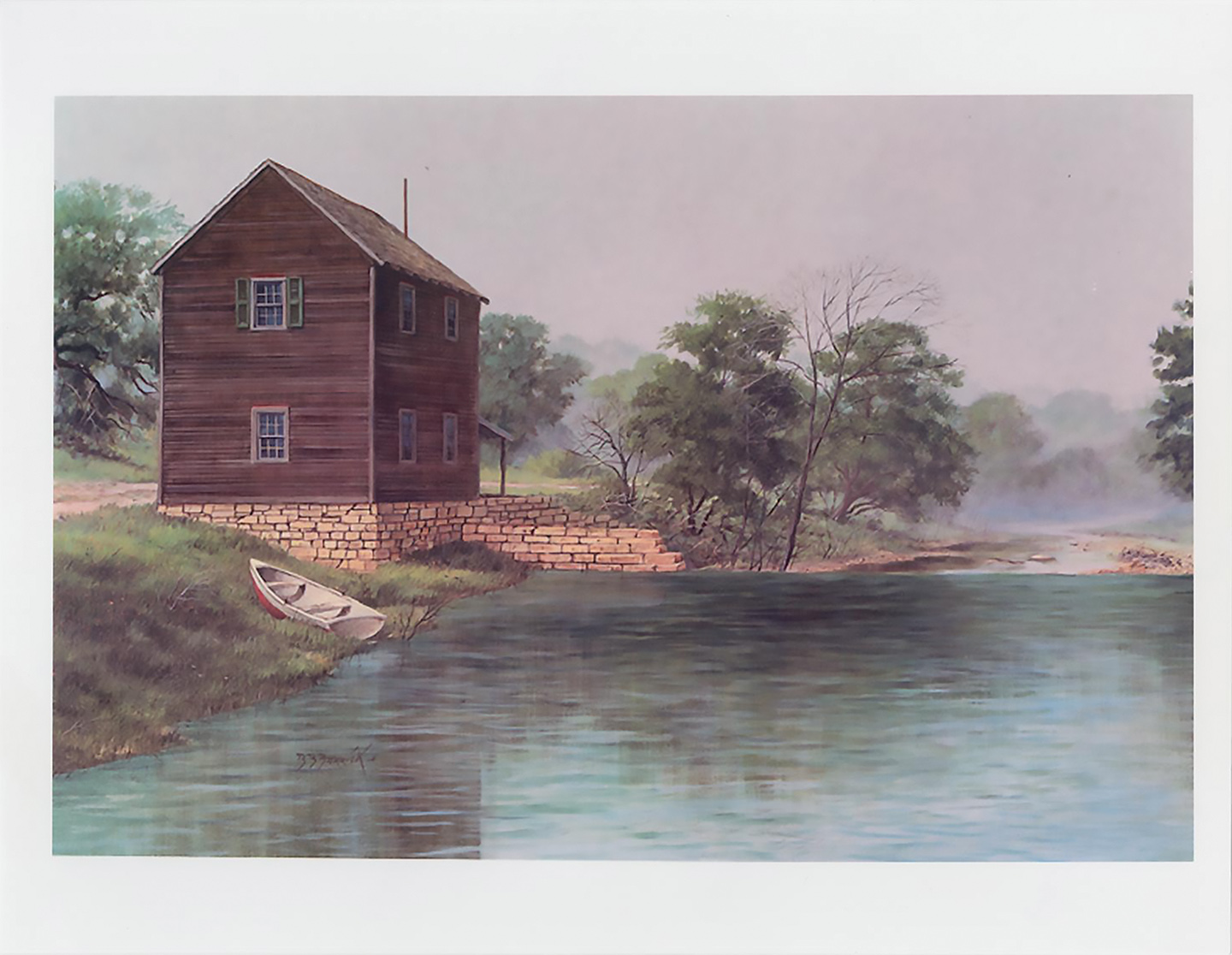
Today, when people stroll along River Road in Boerne, watch ducks on Cibolo Creek or stop beside the dam at River Road Park, few probably realize that they are looking at a surviving piece of one of Boerne’s earliest business enterprises. Long before restaurants, shops and automobiles lined the creek, water flowing through that same spot supplied the power for William Dietert’s sawmill and gristmill.
The Dietert family story is an important part of Kendall County history because it demonstrates something easily overlooked when we talk about pioneers. Settlers could establish a community, but somebody had to provide the practical things necessary for that community to survive and grow. Boards had to be cut for buildings. Grain had to be ground into flour and meal. Roads, farms and businesses had to develop. William Dietert helped make those things possible.
From Germany to the Hill Country
The Dieterts were a family of German craftsmen. Friedrich Dietert and his family came to Texas in the 1850s. His sons included Christian, William, Fritz and Heinrich, or Henry, several of whom became associated with communities throughout the Hill Country.
Milling was particularly important to the family. Christian Dietert became a noted master miller and millwright. After arriving in Texas, he worked at Comfort, where he and Nicolaus Zink constructed the Perseverance Mill on Cypress Creek. Christian later moved to Kerrville, where the mill he established along the Guadalupe River became an important part of that young community’s economy.
Christian Dietert became a noted master miller and millwright. After arriving in Texas, he worked at Comfort, where he and Nicolaus Zink constructed the Perseverance Mill on Cypress Creek. Christian later moved to Kerrville, where the mill he established along the Guadalupe River became an important part of that young community’s economy.
William’s future, however, would be tied to Boerne. William Christian Dietert was born in Germany around 1830–31 and came to Texas during the great period of German immigration into the Hill Country. After spending time in the Comfort area, he moved to the small settlement of Boerne. What he found was hardly the town we recognize today. Boerne had been platted only a few years earlier. In 1859, the community reportedly contained only about ten houses. For a millwright, however, Boerne had one particularly valuable resource: Cibolo Creek.
Boerne’s First Business
William established a sawmill and gristmill along the creek, later joined in the enterprise by his younger brother Henry. The City of Boerne identifies Dietert’s operation as the first business in Boerne. William constructed a dam across Cibolo Creek to harness the water needed to operate the mill.
A gristmill was an essential frontier business. Farmers could bring corn and wheat to be ground rather than processing grain themselves. A sawmill was equally important. Every new house, barn, store, and outbuilding required lumber. In that sense, Dietert’s business was helping manufacture the physical ingredients from which Boerne itself could grow.
The operation evolved with technology. Historical accounts show that Dietert eventually supplemented water power with steam. By 1873, his gristmill was operating two large French burr stones. His operation also included a cotton gin and press, while the sawmill continued producing lumber. This was no longer simply a pioneer with a waterwheel; it had become an industrial enterprise by the standards of a small nineteenth-century Hill Country town.
Building More Than a Mill
William’s investment in Boerne extended beyond his business. He married Rosa Bergmann in 1860, joining another pioneer German family of the region. William and Rosa eventually had nine children. The Dieterts owned numerous properties in and around Boerne, and William developed extensive ranching interests elsewhere in Kendall County, particularly around Spanish Pass and the Upper Balcones area.
He and Henry were also charter members of the Boerne Gesang Verein. That detail tells us something important about these early German settlers: they were building more than an economy, they were building a community. The singing societies, social gatherings, and German traditions of the Hill Country provided connections between families who had left their homeland thousands of miles away. William Dietert helped build the machinery of Boerne while also participating in its cultural life. Then his involvement expanded into government.
Helping Create Kendall County
When residents sought creation of a new county from portions of Kerr and Blanco counties, William Dietert signed the petition supporting the effort. In 1862, the Texas Legislature created Kendall County, and Boerne became the county seat. Dietert subsequently served in county government as both commissioner and county judge. Historical accounts credit him with roughly sixteen years of service as Kendall County judge beginning in 1868.
One story preserved in the county history provides a glimpse of the seriousness with which he apparently regarded public duty. While conducting business in San Antonio, Dietert missed the train back to Boerne. He was expected the following morning to serve as foreman of a grand jury. Rather than simply fail to appear, the story says Dietert began walking home along the railroad tracks so that he could fulfill his responsibility the next morning. Whether viewed as determination, stubbornness or simply nineteenth-century German discipline, it makes a wonderful picture of the man. The miller had become one of the men helping govern the county.
A Family Spreads Across the Hill Country
The broader Dietert family was meanwhile leaving its mark well beyond Boerne. Christian Dietert’s mill became an important part of early Kerrville. Fritz became associated with the Comfort area. William and Henry remained connected with Boerne. The family illustrates how closely intertwined the early Hill Country communities really were. Comfort, Boerne and Kerrville were not isolated settlements. Families moved between them, businesses served surrounding ranches and farms, and relatives established enterprises in neighboring communities.
William also looked farther west. In 1884, he and four of his sons explored ranching opportunities on the Edwards Plateau and eventually acquired substantial ranch property. Portions of those holdings remained associated with later generations of the family, but the Dietert connection to Boerne continued.
Another Generation of Service
William died in Boerne in 1895 and was buried in the Boerne Cemetery. His descendants remained involved in the community their family had helped develop. His son Ernst Dietert married Bertha Pfeiffer, herself from another established Hill Country family. Their son, Clarence E. Dietert, continued the family’s civic tradition.
In 1951 – nearly a century after his grandfather established the mill on Cibolo Creek – Clarence served as mayor of Boerne. That progression is remarkable. William arrived when Boerne consisted of little more than a scattering of buildings. He established a mill, signed the petition that helped create Kendall County, and served as county judge. His grandson later became mayor of the town his grandfather had helped build.
The Mill Is Gone, But the Dam Remains
Perhaps the most interesting part of the Dietert story is that we can still see part of it. The original mill is gone, but the dam associated with the Dietert mill remains along Cibolo Creek at today’s River Road Park. The City of Boerne records that the structure was once known as the Dietert Mill Dam and was part of the old Dietert homestead on the south bank of the creek. The dam was deeded to the City of Boerne in 1912.
Today it has become part of a public park. People walk beside it, fish near it, and photograph the creek without necessarily knowing why the dam was originally there. More than 160 years ago, the water behind it represented power. That power turned machinery. The machinery ground grain and cut lumber. And that grain and lumber helped sustain a frontier settlement that was becoming a town.
The Dietert Legacy
The story of William Dietert reminds us that communities are not built by founders alone. Someone must make them work. Boerne needed lumber, flour, businesses, farms, ranches, and eventually local government. Dietert participated in all of them. His family carried that tradition into another generation and another century.
“The story of William Dietert reminds us that communities are not built by founders alone. Someone must make them work.”
And perhaps there could be no more appropriate monument to the Dietert family than the old dam on Cibolo Creek. The mill has disappeared. William Dietert has been gone for more than 130 years. The little frontier village he knew has become a thriving city. But the water still flows across the place where one of Boerne’s earliest businessmen put Cibolo Creek to work. And every time it does, it passes over a surviving piece of the story of the family that helped put Boerne to work.
From the November 2026 issue of The Kendall Gentleman.
William Dietert’s brother Christian gets his own story in From Prussian Millwright to Texas Trailblazer, and Nicolaus Zink, who built the Perseverance Mill with Christian, is profiled in Nicolaus Zink: A Pioneer of Kendall County Texas. For more Hill Country family history, read The Holekamps: A Family That Helped Build Kendall County. For more from this issue, read John Eddie Vogt’s Musings of JEV: Bert Coryell.
1 thought on “The Dieterts: The Family That Put Boerne to Work”
Comments are closed.