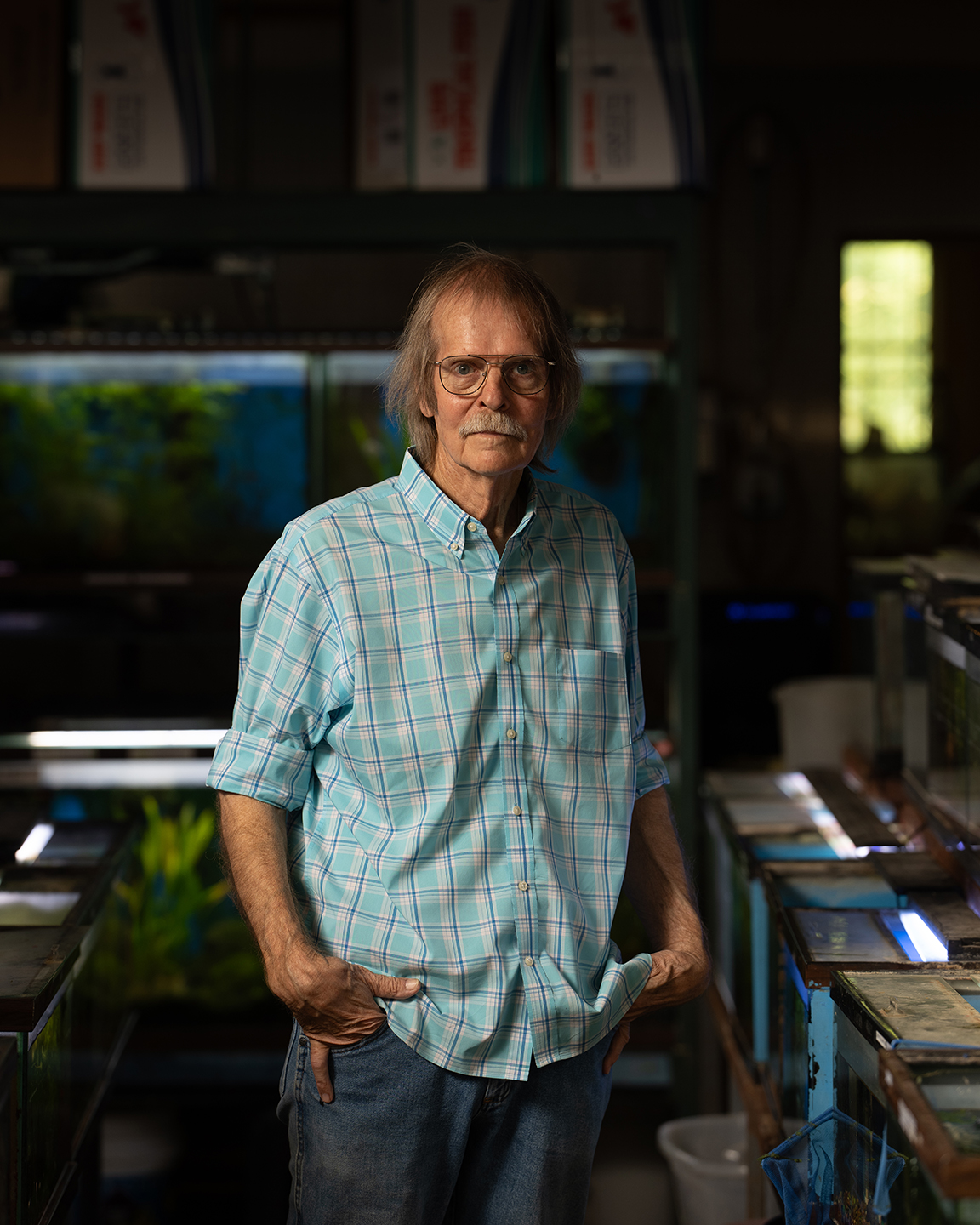
For nearly three decades, Peyton Turk kept Red Crest Pet Shop alive through illness, debt, competition, and a changing Boerne. Now, as the store winds down, the quiet man behind the counter considers what the place has meant to the families who grew up there.
Peyton Turk knew the end would not come all at once.
The dog food would go first, then the cat food and whatever else sold faster than expected. He had stopped ordering inventory that might still be sitting on a shelf after the doors closed. Over six weeks or so, he explained, the store would simply dwindle.
No big ceremony. No dramatic final act. Someone suggested a closing party. “I don’t do parties,” he said.
That is about as close as Peyton comes to making himself the center of attention. Even after nearly three decades behind the counter at Red Crest Pet Shop, he insists the story belongs to the place rather than the man who kept it going.
“It’s not really my story,” he said. “It’s the store.”
“It’s not really my story,” he said. “It’s the store.”
But a store does not survive on North Main Street for decades by itself. It takes someone willing to open the door, feed the animals, pay the bills, clean the cages, answer the same questions and return the next morning to do it again.
For Red Crest, that person has been Peyton Turk.
The City of Boerne describes Red Crest as a local tradition of more than 30 years. Peyton dates his own arrival to 1997, when he says he took over the shop from its previous owner, Bill McCullough.
Getting there took him through Okinawa, California, Germany, Mississippi, Maryland, Austin and the Internal Revenue Service.
Peyton was born in Okinawa into an Air Force family. His father was a lawyer who served as a Staff Judge Advocate. Moving was part of childhood. The family lived near Hamilton and Travis Air Force bases in California and at Ramstein Air Base in Germany. They spent time in Mississippi, where Peyton remembers the family living on the Back Bay of Biloxi. They eventually had a pier and a small boat. Later, the family moved to the Washington, D.C., area.
One year, those moves put Peyton in three different fourth-grade classrooms.
“Three fourth grades in one year,” he said.
Mississippi gave him fishing, boats and time outdoors. Maryland gave him a high-school job at a neighborhood pet store that was mostly devoted to fish. Austin gave him St. Edward’s University, where he earned degrees in biology and English.
It did not give him a plan.
“I really had no idea what I wanted to do,” he said. He took a part-time job with the IRS because he needed work. The temporary job became a career, much of it in the agency’s training branch. “I needed a job, and then suddenly 20 years went by.”
The government job paid the bills, but animals remained the real interest. At one house, Peyton added a room measuring 26 feet by 13 feet. It had tile and drains in the floor and held 26 aquariums. He raised tropical fish and sold them to stores in Austin and San Antonio. Later, the room became an aviary.
It was not a casual hobby. It was years of work performed for the pleasure of doing it well.
His brother Chris, who lived in Boerne, knew about Red Crest and told him the store was available. Peyton met with McCullough and decided it was time for a change.
The first two and a half years tested that decision. Peyton was still living in Kyle and drove to Boerne and back each day. He made less money than he had in government work. “I’d say I make about half what I made at my previous work,” he said, “but I enjoy it.” He paused on that thought. “And, of course, since I’m still here, I still do enjoy it.”
Boerne was different then. Peyton remembers a quieter Main Street and a smaller town where crossing the road required considerably less courage.
“You could close your eyes and walk across Main Street, and you are fine,” he said. “Now you are in danger if you have both eyes open.”
Retail required its own education. Manufacturers and wholesalers wanted shelves filled with their products. McCullough offered simpler advice: Do not buy more than three of any one item until you know it will sell. Peyton learned the rest one bill, one customer, and one animal at a time.
Then the birds made him sick.
He began coughing. He lost between 30 and 40 pounds and struggled with fatigue. The medical testing led to a lung biopsy, a collapsed lung and about a week in an Austin hospital. Peyton said doctors determined that he was hypersensitive to bird dander.
The message from his physician was blunt: “You’ve got to sell your store or get rid of all your birds, or you’re going to die.”
Peyton chose the store. “I said, ‘Okay, I’m not going to sell the store.’”
He removed the birds and adjusted the business. Red Crest expanded its emphasis on reptiles, small animals, fish, and specialty pet foods. Peyton tells the story without inviting sympathy. It was difficult, but it was also a decision. The birds had to go, so they went.
That matter-of-fact response would be tested again.
An important specialty dog-food line suffered a major recall. Competition from larger retailers cut into the store’s business. When another pet retailer entered the Boerne market, Peyton said he kept his staff working and paid even as his personal savings nearly disappeared.
During the store’s early years, he accumulated about $50,000 in credit-card debt. He listened to financial advice while driving and worked his way out of it.
“It took me two and a half years to pay off $50,000 in credit-card bills,” he said, “making not a whole lot.”
At one point, Peyton began counting how many consecutive days he came to the store. He remembers one stretch reaching 683 days. The doors may have stayed closed on Christmas or Easter, but the animals still needed food and water. “There really wasn’t a time when I didn’t want to drive up here and open the door and go in and work,” he said. “Which is something a lot of people can’t say.”
The work was not only about keeping animals alive. It was also about deciding where they belonged. Peyton told of a roughly 30-inch arowana that had arrived at the store at about six inches long. He turned away prospective buyers until someone with a tank large enough to house it came along.
During the final weeks, Pixie remains at Red Crest, but her next home is already planned. Peyton chose a couple who had bought another frog from him years earlier and cared for it successfully. Only after satisfying himself that they could provide the right home did he agree to let Pixie go. “I’m real particular about who gets certain things,” he said.
That sentence explains Red Crest better than any slogan could. It was a store, but the transaction was not always the highest priority.
Customers noticed.
Some came for aquarium plants or specialty food. Others came for advice about fish, reptiles, and small animals. Children came to see what was in the tanks and cages. Families stopped by even when they did not need to purchase anything.
“For a lot of people, it was a destination, not a chore to come here,” Peyton said. “It’s something they wanted to come to, a lot of them just for the heck of it.”
Over time, children who had visited Red Crest began returning with children of their own. As word of the closing spread, customers stopped in to tell Peyton what the store had meant to them.
“We had a lot of people come by lately just to say the store has been part of their family,” he said. “Which is nice.”
Employees grew up there, too. Peyton estimates that roughly 20 people worked for him over the years. He recalls that two went on to become veterinarians, while others became a nurse, a teacher and business owners.
He does not call himself a mentor. He speaks instead about having good luck with people.
That is Peyton’s way. He understates his own part in nearly everything.
Outside the store, change is coming to the property as well. The building on N. Main St., which houses Red Crest and Boerne Grooming, is part of the proposed Park Plaza redevelopment. Plans call for replacing the existing structure with an approximately 11,400-square-foot, two-story retail building. A June 2026 tie vote on demolition was initially treated as approval, then reversed after city legal review determined that the tie did not authorize demolition.
The redevelopment adds another layer of change to Peyton’s decision. He had explored moving Red Crest about a decade earlier, but concluded that higher rent, renovation costs and the business lost during a move would make relocation difficult. This time, he chose to wind the store down.
He is doing it deliberately. He is not buying too much. He is finding homes for the animals. He is letting the shelves empty in their own time.
He does not know exactly what comes next.
A friend who had already closed a business offered him advice: When you lock the door, walk away and forget it. It is over. That may be easier said than done.
For nearly 30 years, Red Crest was where Peyton spent most of his waking hours. It was where he met Boerne, watched the town grow and saw generations of customers pass through the same door. It was where he gave up the birds he loved, survived hard years and built a life he had never planned.
He still does not want to make too much of it. “It’s been good,” Peyton said. “I’ve enjoyed this.”
Then he added the part that mattered: “That’s important.”
For nearly three decades, Peyton showed up, cared well for what had been entrusted to him, and gave Boerne a place worth remembering. That is why Peyton Turk is The Kendall Gentleman.
Key Facts
- Full name: Peyton Turk
- Born: Okinawa
- Roles: owner of Red Crest Pet Shop; former IRS employee
- Issue: September 2026
From the September 2026 issue of The Kendall Gentleman.
This issue’s Publisher’s Note, Knowing What Is Important, reflects further on Peyton’s story. For more from this issue, read Officer Jeffrey Wilson’s profile in Grounded in What Matters. For more cover stories on Kendall County business owners, read The Man Who Built Joy and Bill Whitworth and the Quiet Work That Holds a County Together.