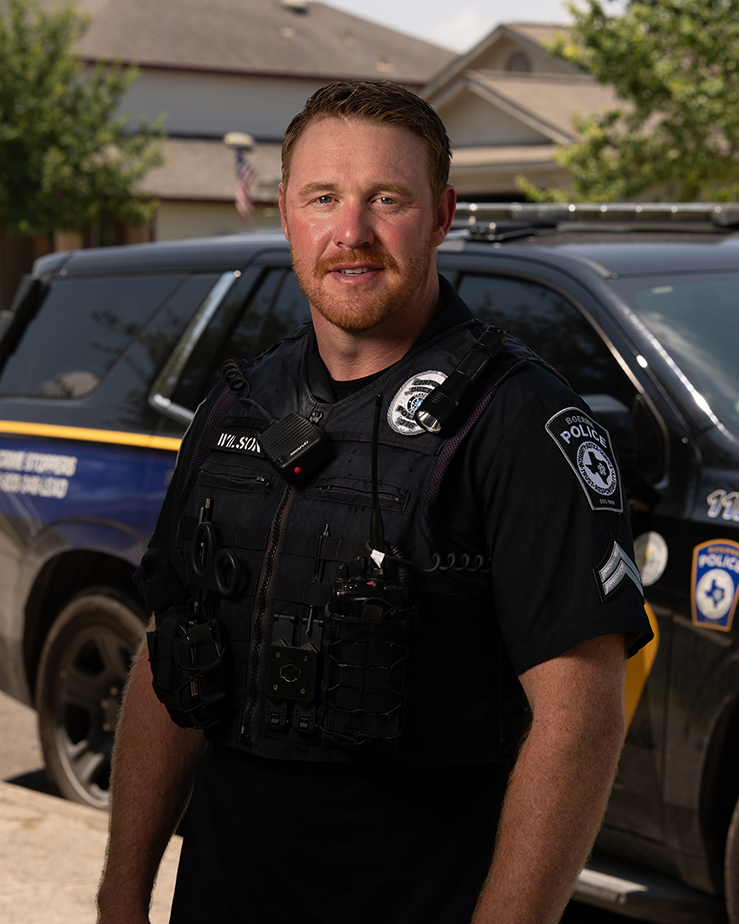
Officer Jeffrey Wilson on faith, family, accumulated trauma, and the support that helps first responders keep showing up
For Officer Jeffrey Wilson, law enforcement grew from a childhood belief that public service could make a difference. Both of his grandfathers were Green Berets, a cousin served as a police officer, and family friends included a U.S. marshal. The examples around him made service feel both familiar and worth pursuing.
“I always kind of felt that maybe delusional feeling like I could change the world or make a difference,” Wilson said. “That’s what really led me into it.”
Learning to Reach People
Wilson grew up in Lehi, Utah, and served a mission in Washington state through The Church of Jesus Christ of Latter-day Saints. Years before he wore a badge, that experience taught him how to approach strangers, absorb hostility, and keep a difficult conversation from becoming a damaging one.
“Your whole job is to either talk to people about Jesus or try to provide a service,” Wilson said. “When someone’s really angry at you, you try and talk to them and at least have a good experience talking to them. I definitely learned to talk to people. That was a big one.”
Those skills translated naturally into de-escalation and police work. When Wilson entered the academy, the fit became even clearer. He had never considered himself a strong student, but he earned some of the highest test scores in his class.
“It just all felt good,” he said. “It was like where God wanted me to be.”
During more than a decade in law enforcement, Wilson has helped locate a child in an Amber Alert, written major search warrants, and helped disrupt criminal activity. Even when describing those successes, he is quick to deflect credit.
“That wasn’t me,” he said. “I definitely had help.”
What the Badge Does Not Show
The public sees an officer’s uniform and authority. Wilson says it rarely sees what may have happened on the call immediately before an ordinary interaction. Early in his career, one of his friends was shot and killed. He has also responded to repeated incidents involving the deaths of children.
“I don’t think people understand what we see,” Wilson said. “You may get an officer that was less than cordial with you, and maybe 45 minutes ago he was at a death scene for an infant.”
That does not remove an officer’s responsibility to treat people well. Wilson is careful about that distinction. “It’s our job to manage it and to show up and be who we need to be when we go to somebody’s house,” he said. “But it would be nice if people understood that.”
The effects do not always arrive in an expected form. Wilson recalled one of his young daughters screaming after getting into an ant pile. The sound suddenly pulled him back to a call in which a child had died. His reaction was stronger than the moment called for, and his wife recognized that something deeper was happening.
“When I realized some of the things I’ve seen were bugging me, it wasn’t how I imagined it would be,” he said. “That’s where you recognize that emotionally you need to regulate, and it takes a lot of work.”
A Foundation Strong Enough to Hold
For Wilson, faith is the center of that work. Family, prayer, and the ability to recognize the blessings waiting at home help him reset after difficult calls and seasons.
“I really believe that my faith in God is what has helped me heal from a lot of things,” Wilson said. “Just relying on our Savior.”
Sometimes the reset is only a simple prayer or a few quiet moments in the car before he walks through the door. Then he returns to his wife and daughters, who are homeschooled and enjoy hunting with him.
“I go home and see how blessed I am with my kids,” he said. “They’re healthy and happy. That stuff kind of brings you back to reality.”
That grounding is also what he urges younger men to establish before entering law enforcement. “They don’t do a good job of talking about what it does to you,” Wilson said. “Have something that you’re grounded in.”
Support That Goes Looking
Wilson first encountered Hope for Heroes Texas through recognition events for officers who had endured traumatic experiences and through the organization’s luncheons. The level of community support stood out because it was different from what he had previously known.
He later learned that some of Hope for Heroes Texas’ most important work happens privately. Wilson knows of a responder Brad Cornell approached after recognizing that the individual was struggling personally and financially. To protect that person’s privacy, Wilson did not share details. What stayed with him was Cornell’s persistence.
“He continued almost aggressively to help him out,” Wilson said. “Like, ‘We’re going to help you. We’re going to help make you whole.’”
That initiative matters in a profession where people are often reluctant to admit that they need anything. “We’re not very good at going to seek it out,” Wilson said. “Brad just got in and asked me some of the tough questions, and then immediately had things that he suggested, resources that he would make possible.”
Wilson sees the organization’s value in the fact that its support does not stop at conversation.
“They’re out doing it,” he said. “Having an external organization that is willing to put their money where their mouth is and help people and provide resources, it’s huge.”
The Small Moments That Make It Worth It
Wilson and his wife returned to the Texas Hill Country after ten years in Utah. His wife grew up in Boerne, and serving near home restored the sense of purpose he felt while policing the community where he was raised. As Kendall County grows, he believes preserving trust depends on continuing ordinary contact between officers and the people they serve.
“Every time I go to some activity like that and interact with the citizens and see that support, it’s like, this is good,” Wilson said. “This is what kind of preserves that.”
He has seen that willingness to help after family tragedies and during recent flooding, when residents donated money, supplies, and labor as soon as they were given direction. He has also seen hope in the people he once encountered at their worst who later stopped him to say they were sober, staying out of jail, or building a better life.
“Those little things, like you helped be a part of making a difference, get you through,” Wilson said. “You know that it is for something.”
Message from Brad Cornell
“Jeffrey’s story shows why first responder support has to be personal, persistent, and available before a crisis becomes unbearable,” said Brad Cornell, founder of Hope for Heroes Texas. “The men and women who serve our community are exposed to difficult things over and over, and too often they are expected to carry that weight quietly. Hope for Heroes Texas exists to go looking for the person who may not ask for help, to listen without judgment, and to connect that responder and family with meaningful support. Jeffrey understands that faith, family, peer connection, and community all matter. Our job is to make sure no first responder in Kendall County has to carry the burden alone.”
From the September 2026 issue of The Kendall Gentleman.
Officer Jeffrey Wilson’s story continues The Kendall Gentleman’s Hope for Heroes Texas series, alongside Hope for Heroes: Serving the Community He Calls Home and Hope for Heroes: Jose Javier Escalante from recent issues. For more from this issue, read Jed Mazour’s Summer Shootout at Inks Lake.