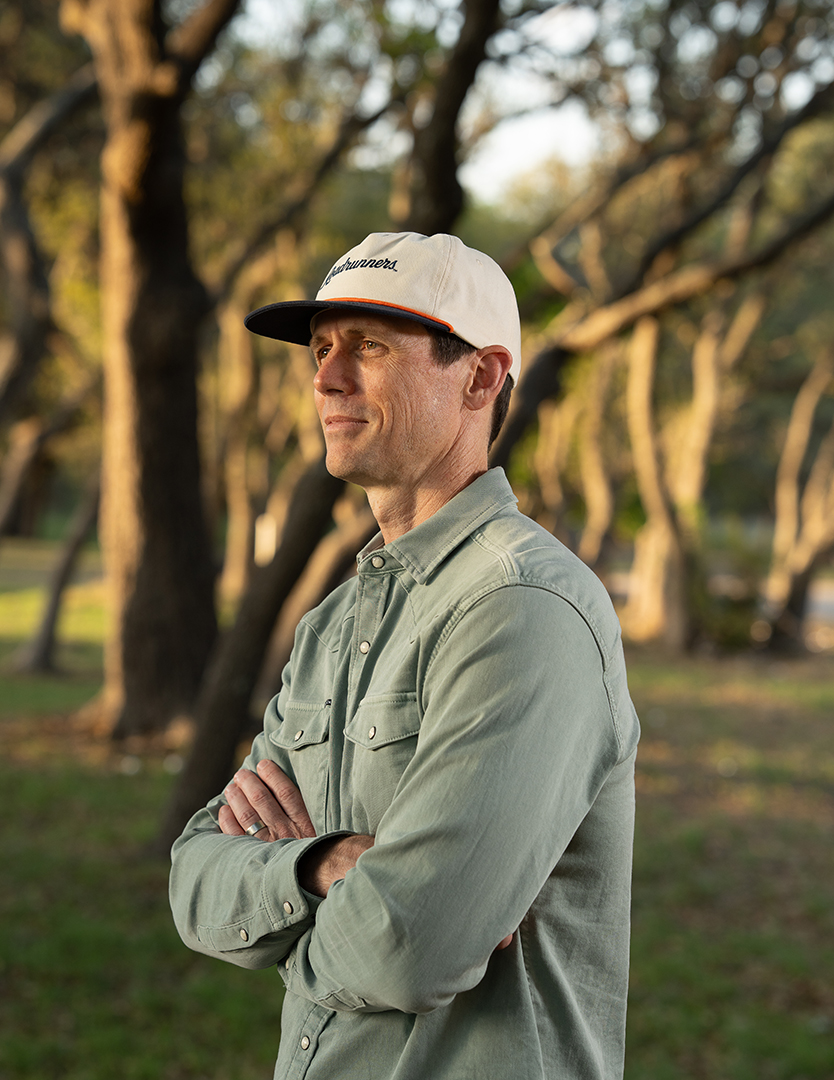
When Danny Phillips bows his head before we begin, we are not in a sanctuary. We are in his office. A small, curly-haired black dog wanders the room, settling and resettling as if this is a familiar rhythm.
Outside the window behind him, an enormous oak tree fills the frame, its branches stretching wide across the front yard, older than the conversation taking place beneath it.
He gives thanks for the opportunity “to reflect and remember all of your goodness and beauty that takes place in this place, in this city.” He prays that God’s work, not his own, would be what is evident in the conversation, and asks for guidance, wisdom, and discernment.
The prayer is brief. It does not draw attention to itself. It sets a posture.
“See this tree behind me?” Danny Phillips says. “It’s got a lot of limbs and branches. That’s my family.”
Roots and belonging
When Danny talks about where he comes from, he does not simplify it. His parents were previously married. His family includes half-siblings, cousins, and overlapping households that never fit neatly on paper. “I’ve got two older brothers, both four years older, and they’re not twins,” he says. “They’re twelve days apart.” Those brothers, Johnny Johnston and Brent Keith, grew up alongside him in a family where proximity mattered more than labels.
What mattered was not how the family was described, but how it lived. “We were just always brothers,” Danny says. “There was no half-brother talk. There was no, ‘well, he’s not your real brother.’” He remembers one of his brothers coming home from school in tears after being told otherwise. The family never accepted the distinction.
The roots ran deep, intentionally so. Danny’s mother spent decades serving children as a weekday preschool director, and his father served the community for years in municipal court. “They wanted to find a spot and plant deep roots,” Danny says. That posture shaped the household.
“We traveled together. We went on trips together. I’ve performed all of their weddings like we were best men in weddings,” he says. The relationships remained practical and immediate. “I can call John or Carmen right now and be like, ‘Hey, I’ve got this leak downstairs,’ and they’d be like, ‘I’ll be right there.’ And on the other side, they can call me and say, ‘I’ve got an issue. I need you,’ and I’m coming.”
Around Kendall County, the connections are known, if not always easily explained. “If you ask people around town, like, ‘hey, the Phillips Johnston Wade connection,’ what is it?” Danny says. “Every once in a while somebody can explain it to you. It’s complicated.”
He says that without embarrassment. Like the oak tree he gestures toward, the family has grown outward in multiple directions, shaped by time, proximity, and shared life. The roots held. That sense of belonging, learned early, would later become both a gift and a tension when his identity was tested elsewhere.
Baseball and readiness
Baseball arrived early and stayed long enough to matter. Danny played through high school and into college, carrying the familiar weight that comes with competitive sports. “I enjoyed it,” he says. “It was a gift. It was a lot of fun. It taught me a lot.”
One moment still stands out, not because of a stat line, but because of how it happened.
During a high school tournament in Boerne, Danny was sitting in the stands when a player was injured midgame. He was not dressed to play. He was not listed on the lineup card. “I was literally in the stands watching the game,” he says. Someone asked if he was there. He ran to his truck to grab his gear, returned, and was briefly told he could not enter because he wasn’t on the lineup. Moments later, he was called back again.
“I throw a jersey on,” Danny says. “Number sixteen was the manager’s jersey. And I go in and end up playing the rest of the game.”
The moment stayed with him. Not because of the outcome, but because he had been pulled from the stands, unannounced, and asked simply to be ready.
He remembers places as clearly as plays. A grand slam at Antler Field. The lights. The grass. The feeling of being part of something local and temporary at the same time.
Over time, though, he began to notice the quiet pressure underneath the game. “My emotional and mental state would rise or fall based on how good I did on the field,” he says. “That’s an awful way to live, especially offensively. In baseball, you’re meant to fail a lot.”
A turning point came when he began traveling with Athletes in Action, a sports ministry that took him through Latin America for multiple summers. “That was the first time I was around a group of men that didn’t treat baseball as a god,” Danny says. “I got to experience people that loved Jesus and didn’t place their identity in the sport.”
That shift mattered. “I actually relaxed and played the game more freely because I possessed a different type of freedom,” he says. Baseball did not disappear, but its authority did. The lesson was subtle but lasting. Readiness was good. Performance as identity was not.
He remembers his final game clearly. “I knew that I was done, and I was okay with it,” Danny says. “I don’t want to be done yet, but I got to experience that. And that made it easier to let go.”
Even now, when asked what he misses, the answer surprises people. “I don’t miss the games,” he says. “I miss practice. Honing a skill. Giving everything I had that day. That was the part I loved.” That posture, effort without spectacle, would follow him into the next season of his life.
Leadership, loss, and restraint
Years later, those same lessons resurfaced under very different pressures.
Danny helped lead a young church community during a season marked by growth, expectation, and intensity. What began with energy and conviction slowly took on a different shape. Decision-making narrowed. Authority centralized. The pace quickened in ways that left little room for disagreement or rest.
The work carried genuine beauty. It also carried weight.
“My world had been completely disoriented,” he says. “I was doing my best just to stay above water. There are seasons where you are just trying to remain present.”
When that chapter ended, it did not resolve cleanly. It ended abruptly, leaving unanswered questions and fractured relationships in its wake. What followed was not relief so much as exhaustion. Grief without ceremony.
In the months that followed, former leaders and members gathered for evening worship services in borrowed spaces around Boerne. The meetings were sincere and unstructured, shaped by shared history and a collective need to breathe. There was no agenda beyond being together. No attempt to explain what had happened.
Even there, Danny felt the pull to slow what others were eager to organize.
“We had no business trying to start something out of brokenness,” he says. Healing had to come before direction.
What he resisted was not faith, but momentum. He had learned earlier that willingness is not the same thing as readiness. That urgency can disguise itself as obedience. That not every call is a summons to build. Sometimes it is an invitation to stop, to listen, and to let the ground settle before anything new is attempted.
That restraint would become formative rather than corrective.
Work, study, and orientation
After stepping away from public leadership, Danny did not step away from formation. His days are now shaped by operational work marked by schedules, logistics, and responsibility rather than visibility. The work is grounded and demanding, and it clarified what kind of attention his life now required.
Alongside that work, Danny is pursuing a Doctor of Ministry degree at Northern Seminary, with a focus on contextual theology. It is a way of studying faith that pays close attention to place, culture, and the lived experiences of the people in front of you. The decision was not a return to prominence, but a commitment to remain teachable.
“I signed up for the doctorate program because I want to be a continual student and learner,” he says. “From a real practical standpoint, I learn best when I have a teacher and a curriculum and a pathway.”
Experience alone, he believes, is not enough. “Just because you’re a pastor doesn’t absolve you from learning and growing,” Danny says. Over time, he has become wary of intellectual comfort. “We can sit in our own echo chambers of the people that we like, the people that we agree with. There’s no shortage of people that we agree with, and we can find them anywhere.”
What he sought instead was friction. “We will be sharpened when we push outside of those and allow this friction point to take place,” he says.
He entered the program during a season of uncertainty. “Cynicism would have been a super easy path,” he reflects. Instead, the structure of study provided orientation. “The program and the people that I’ve been on the journey with have provided so much orientation and an opportunity to learn through that in a rather disorienting season.”
The theme is consistent. Slowing down did not diminish his calling. It clarified it.
Vocation, practiced
Danny’s current work does not look like ministry in the way people expect it to. He works in operations for Churchill USA, a roofing and restoration company. The shift took time to understand, even for him.
“It’s been such a gift to my family,” Danny says. “The people within that space have been a healing presence. A place where people show up day in and day out and draw things out of you that you didn’t think you had left to give.”
He pauses, then asks the question himself. “Now all of that I just described to you. Does that sound like a roofing company?”
For Danny, the answer is not about industry. It is about vocation.
He points to a distinction articulated by author Karen Swallow Prior, between a hobby, a job, a career, and a calling. A job can be given. A career can be ended. Vocation is different. It is a divine invitation.
“No one can give your vocation to you the way a job can be given,” Danny says. “And no one can take your vocation from you the way even a career can be ended.”
The work changed. The invitation did not.
“I’ve switched jobs a couple of times now,” he says. “But the invitation to shepherd, to walk beside people, to pay attention to where the Lord is at work and join Him there, that hasn’t changed.”
That invitation now takes place in conference rooms and job sites rather than sanctuaries. In listening before fixing. In showing up consistently. In remaining attentive to the people directly in front of him.
“It happens to take place within a roofing company right now,” Danny says. “But it’s the same calling.”
Family, time, and staying
The commitments Danny describes are no longer theoretical. They are practiced at home.
He and his wife, Lindsey, are raising two daughters in Kendall County, in the same place that formed him. Staying has given his life a longer view. It has allowed him to remain part of the community in ordinary ways, not as a figure moving through it, but as someone rooted inside it.
“I can still be a part of this community because of this job,” Danny says. “I still get to grab a meal or meet for coffee or go to games, lead a Bible study, because I have a job that recognizes the value of investing in people.”
What he describes is not efficiency, but continuity. “If we’re around a spot long enough,” he says, “you get to see the compounding result of that.”
He has watched children grow from middle school to graduation, from marriage to parenthood. “Then they’re walking in with their babies and toddlers and elementary school kids,” he says. “And I’m like, this is weird. I remember you as a twelve year old.”
The moment lands with humor, but also gratitude. “This is the beauty of what a community should be,” Danny says. “Man, what a gift.”
That perspective now shapes what he is building at home. The restraint he learned through leadership, loss, and study has become intentional. It informs what he wants his daughters to inherit. Not urgency. Not performance. But presence, belonging, and the freedom that comes from being known over time.
Staying
Danny does not speak about Kendall County as a destination. He speaks about it as formation.
“When I think about what formed me growing up,” he says, “I think about family. I think about my friends’ families. And then my third layer was the people within church, within the field or the court. Those relationships happened in different spaces, but they were all formative.”
Places like Antler Field remain part of that memory. Not as nostalgia, but as evidence of how ordinary spaces accumulate meaning when people remain. Games were played there. People showed up. Life layered itself over time.
Only six of Danny’s years have been spent somewhere else. “I’ve been in this house for twenty five years,” he says. Staying was not an accident. It was learned, practiced, and chosen again and again.
Like the oak tree behind him, Danny’s life is marked less by moments of visibility than by years of quiet growth. Branches reaching outward. Roots pressing deeper.
What endures is not how often he was called forward, but how faithfully he stayed.
Key Facts
- Full name: Danny Phillips
- Hometown: Kendall County
- Roles: operations at Churchill USA; Doctor of Ministry student at Northern Seminary
- Issue: May 2026
From the May 2026 issue of The Kendall Gentleman.
More from The Kendall Gentleman: for another story where faith and community are the foundation of everything, read Brewing Bold Faith in Boerne: The Casey Barker Story. And for a man who found his calling in an unexpected corner of the Hill Country, Harvesting Legacy: Andy Ivankovich’s Mission of Service and Strength is worth the read.