The 30,000 acre Continental Ranch sits just outside of Comstock Texas. Flanked by the mighty Pecos River on her west and no man’s land on her east. In 1836 Texas won its independence and the battle to settle a claim of your own was an appealing offer to young, tough ambitious men. It’s thought that sometime around the 1880’s is when Mr. Prosser was granted the land, now the Continental Ranch, from the Republic of Texas. Although this would make him the first owner on record, the ranch was inhabited by a few feral homesteaders. Mr. Gobel and a man they called Julio. As the story goes, Mr. Prosser let these men continue to live their time out on the ranch. Maybe as payment for help in the infancy stage of the ranch’s development but nobody knows for sure. In 1883 the Transcontinental Railway was under construction through Comstock. This would bring an influx in Chinese labor as well as the first time goods like grains, lumber, tools and other necessities needed for a homestead would be accessible in such a remote area. This was the beginning of a new Texas frontier and the nation’s second largest economy.
I’ve had a special hunt in my mind for a long time. One I dreamed would take me to the most wild places in the state. I dreamed of panoramic views without civilization in sight. I dreamed about terrain so rough it would test my mental fortitude. I wanted the ability the take my best and my longest shot. I didn’t want any guarantees but rather, all the risk. All of these requirements would lead me to a conversation with Bryan Fischer of Texican Outdoors. Bryan and I grew up together here in Boerne and we have been following each other’s adventures for years. His hunting career has taken him all over the Western United States, into Canada and Alaska. Every so often we will meet at Cibolo Creek Brewing Co. and tell stories of our past season hunts and our future aspirations. Texican Outdoors holds the lease for Aoudad hunts on the Continental Ranch and Bryan was convinced this was what I was waiting for. After conversations about Indian camps, giant free range sheep, and the vast landscape I was convinced myself. It’s mid-January and whitetail season is quickly coming to a close. Instead of packing away all of our gear, we were prepping for a trip to the Del Rio area. The border lands of South West Texas are not new to my family. We have been fishing Lake Amistad for years, kayaking the Devils River, and had a deer lease in Mexico. Even with that amount of experience in the area, I would find myself feeling as if it was the first time I had stepped foot in the region.
The Aoudad sheep. Originally from North Africa, was introduced to Texas, specifically Kerr and Llano county, in the late 1940’s after World War Two. Fast forward 80 years, Aoudad are now in game ranches across the entire state and the free ranges of South and West Texas. Their resilience has allowed them to thrive in the harsh desert conditions of Val Verde county. An area that just closed a chapter on a 22 month drought. Surviving on chamizo, yucca plants, mesquite leaves, and even prickly pear cactus, with the ability to go days without water. This animal is well suited for survival. What is so appealing? Well, take a look for yourself. A mature Aoudad can weigh around 300 lbs. Rams are known for their 30+ inch horns and golden blonde chaps running down their chest and legs. They have a very masculine and dominant presence.
Comstock Texas January 7th 5:30 AM – JT is in the kitchen making biscuits and gravy. Bryan looks like he’s been ready since yesterday! Everyone sits at the table for a hot meal before we hit the dusty trail. It could be dark by the time we make it back. Lights off, stars out, we advance into the great wide open plains of the Continental Ranch still under the cover of darkness. A few miles down the trail, Bryan finds a spot to stash the Ranger so we can position ourselves. The sun will rise soon and the sheep will be looking to warm up, making them visible while we still keep a good distance. This is a much farther and exposed pursuit than I am use to and that’s exactly what I wanted! Hunter spots a herd about a half a mile or so out. Bryan get on the spotting scope to investigate. No mature rams. This was the first time I had seen a herd of over 60 sheep! They moved in a tight formation across the land effortlessly, as if it were free of any cactus or other obstacles. Over the course of the next few days this would be a common scenario.
Taking a break midday, Bryan wanted to do a little show-and-tell. Radio on and a few cold libations, we kick back a bit for a relaxing cruise across miles of the ranch and eventually down into the Pecos River valley. As we make our way, he tells us stories of the early homesteaders, shows and identifies the vegetation these animals survive on and tries to convey the sight we are about to see. As we come down the ridge, the Pecos comes into sight. I have seen a lot of miles of rivers across the country. I have kayaked down the Devils, fly fished across the Idaho Rockies, and just about everywhere in between. To be completely honest, this was one of the most beautiful sights I have ever seen. Her banks are flaked on both sides by shear 200-300 foot cliffs in what seemed to me like a form of protection. Lush green grasses and small shrubs hugged the banks. Most impressive of all, her clear, yet rich, emerald green waters nourishing an abundance of thriving fish. As if a treasure for whomever braves the hellacious land. A lifeline for history’s survivors. Some of them leaving behind their own stories of the area in the nation’s largest petroglyph sight and multiple caves bearing the limestone canvas pictographs.
The three of us hiked for hours exploring the carvings and paintings, trying to wrap our minds around what they might be telling us in these ancient artifacts. Who knows, we sure don’t. But I am pretty certain they felt as if they found a treasure, security and lifeline when settling on the river’s banks and caves. It would be impossible to sit at the river’s edge or cliffside peaks and not wonder what it might be like to be in the exact same spot 600 or even 6000 years before. Probably the most intriguing thing is that almost nothing has changed.
It’s around 6 AM Friday morning. Stomachs are full of chorizo, huevos y queso tacos, courtesy of JT. The sun rises and immediately Hunter spots a herd across the canyon. The morning starts with a quick pace! Bryan glasses and spots what seems to be a decent ram but it’s difficult to be certain with them on the move. These sheep can cover ground at an incredible pace. Even if we were to go high diddle diddle, straight up the middle, we would never catch up to them in the mine fields of dog pear cactus and almost zero cover. We decided to head around them a few miles to try and catch the rear of their movement. Seemed like a long shot to me but Bryan was fully engaged and in motion. We tore down the trails in the Ranger like a Comanche onto their foe. Pulling up to a ridge above their last know location, we drop any gear we can in order to move as quick as possible. This would catch up to me later… Much to my surprise, we caught up with the rear of the herd completely undetected and I still don’t know how that was possible. The sheep made their way to a ridgeline, warming up in what they thought was a secure spot. We stayed below the horizon, behind a large Spanish dagger and groups of smaller yucca’s. As long as we didn’t give our position away, we had the time needed to examine the herd and gauge the ram’s size. The ram in discussion was over 500 yards away at this point. It became very apparent that if I was going to take a shot, not only would it be a long shot but potentially my furthest, something I was hoping for but nervous about. A week or so before this hunt I had just completed putting together a new long range rifle and optics. Christensen Arms Modern Carbon 300 PRC, a light weight rifle perfect for this situation! The only catch was I had one day in the field to zero this rifle before coming, so my confidence as rifle and rifleman hadn’t been developed yet. We hid there for a bit working on a decision to squeeze the trigger or wait for another opportunity. As the saying goes, “don’t pass on something the first day for something you would shoot on the last”.
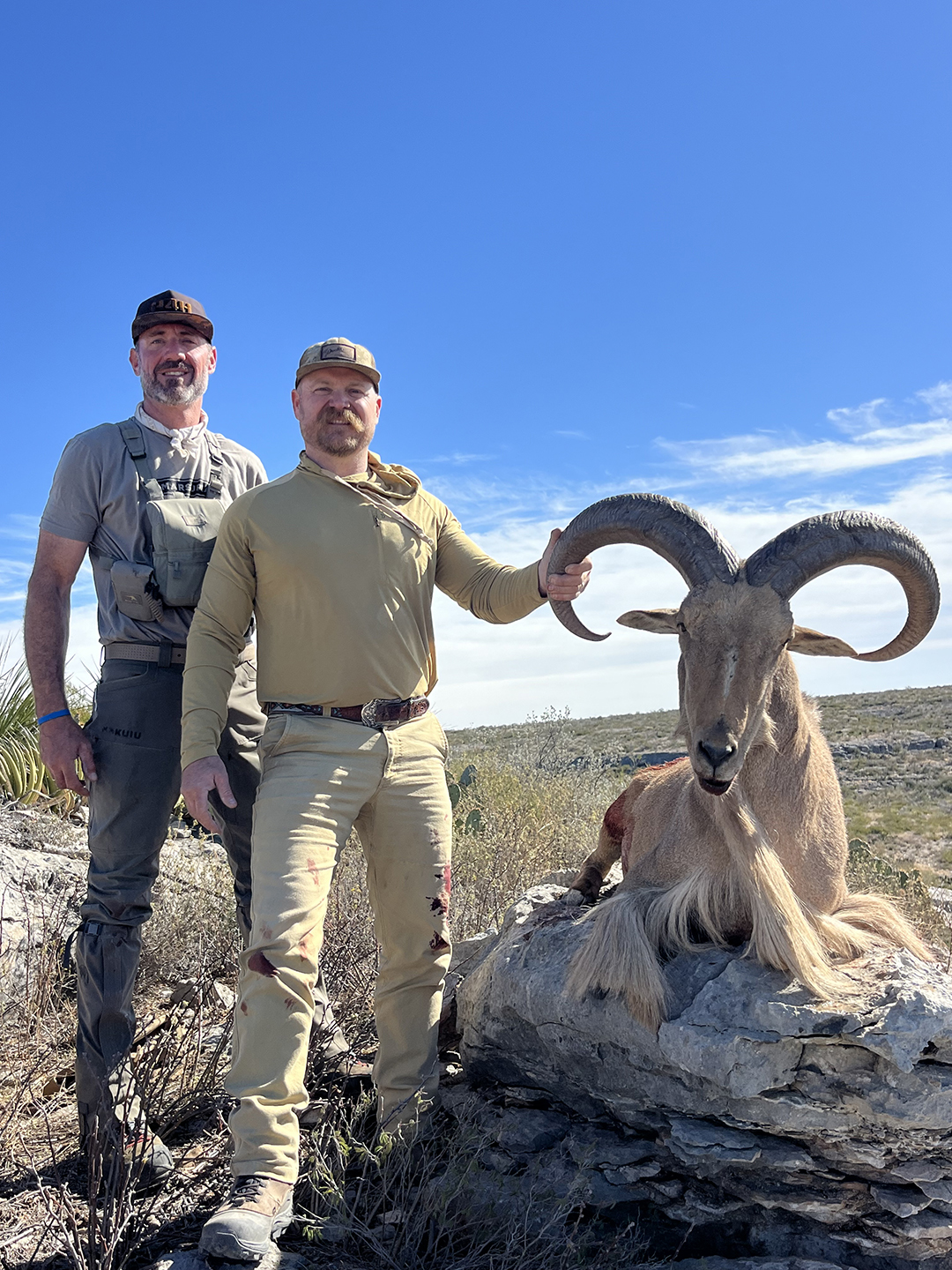
That was it, that’s all I needed to think about. After all, I did not come for a “trophy”, but for the whole experience and here it was. My mind was set. I pushed up another 50 yards or so. Hunter and Bryan both ranged it, 465 yards. This would be my furthest shot I have ever taken and if I land it, my best shot. I take a few slow breaths to control my breathing and time my trigger squeeze with my exhale. Slow squeeze. Aim small, miss small. The rounds sail across the canyon, finding its way directly into the side of the ram. “Hit”, Bryan yells! Bringing my barrel back into control, I am trying to re-acquire the ram in my scope. Not taking my time, I send another round and miss. “Directly in front of his face!” Hunter and Bryan yell. “he’s sick, take your time” says Bryan. I settle down and think about my movements. Breath and slowly squeeze the trigger. This round knocks him completely off a rock and onto the ground. In full transparency, it was 6 shots total, 3 hits, 3 misses. We briefly celebrate then eagerly make our way to the ram. Down one end of the ravine and back up the other through the dog pear and myriad of other cactus. Coming up I can see the ledge he was standing on when he took the last shot. There he was, laying right behind it! As soon as we see him, any concern about aging or size was gone. He was a beautiful mature ram, 31 ½” with golden blonde chaps running down his chest and legs. We sat there and celebrated, talk about the play by play, our decision to shoot, the ground we covered and everything in between. Then it was time to get him cleaned up, head strapped to a pack and hiked out. This part might seem insignificant or small but it’s actually a “pride of the hunt” moment. Whether it’s a mule deer, elk, ram or any other big game, strapping the skull and horns to your pack and hiking it out is the closure every hunter wants. You might have miles of pure exhaustion and misery in front of you but that is completely insignificant in this moment. For me, a few cactus covered hills and ravines but nothing too harsh. The three of us collect back at the Ranger for an ice cold yellow belly! There are only a few times a beer can taste this good and I can’t think of the others.
We spend the next day and a half glassing sheep in the distance, exploring the Indian trails and dwellings, taking some hasty shots at quail and just grounding ourselves at the tops of 300’ cliffs. Like any successful trip, we celebrated into the night telling stories and sending smoke up and into the celestial landscape just as the Indians did after a successful hunt, or at least I’d like to think so.
“The credit belongs to the man who is actually in the arena, whose face is marred with dust and sweat and blood; who strives valiantly… who knows great enthusiasms, the great devotions; who spends himself in a worthy cause; who at the best knows in the end the triumph of high achievements, and who at the worst, if he fails, at least fails while daring greatly, so that his place shall never be with those cold and timid souls who neither know victory or defeat.” Teddy Roosevelt
Jed Mazour
From the March 2026 issue of The Kendall Gentleman.
From the Texas outdoors: the Pecos has more stories than one trip can hold. For another encounter under that wide-open sky, read The Pecos River and The Starlight Canvas. And for the kind of border-country adventure that reminds you why Texas maps end at the river, Las Cuatas is well worth the detour.