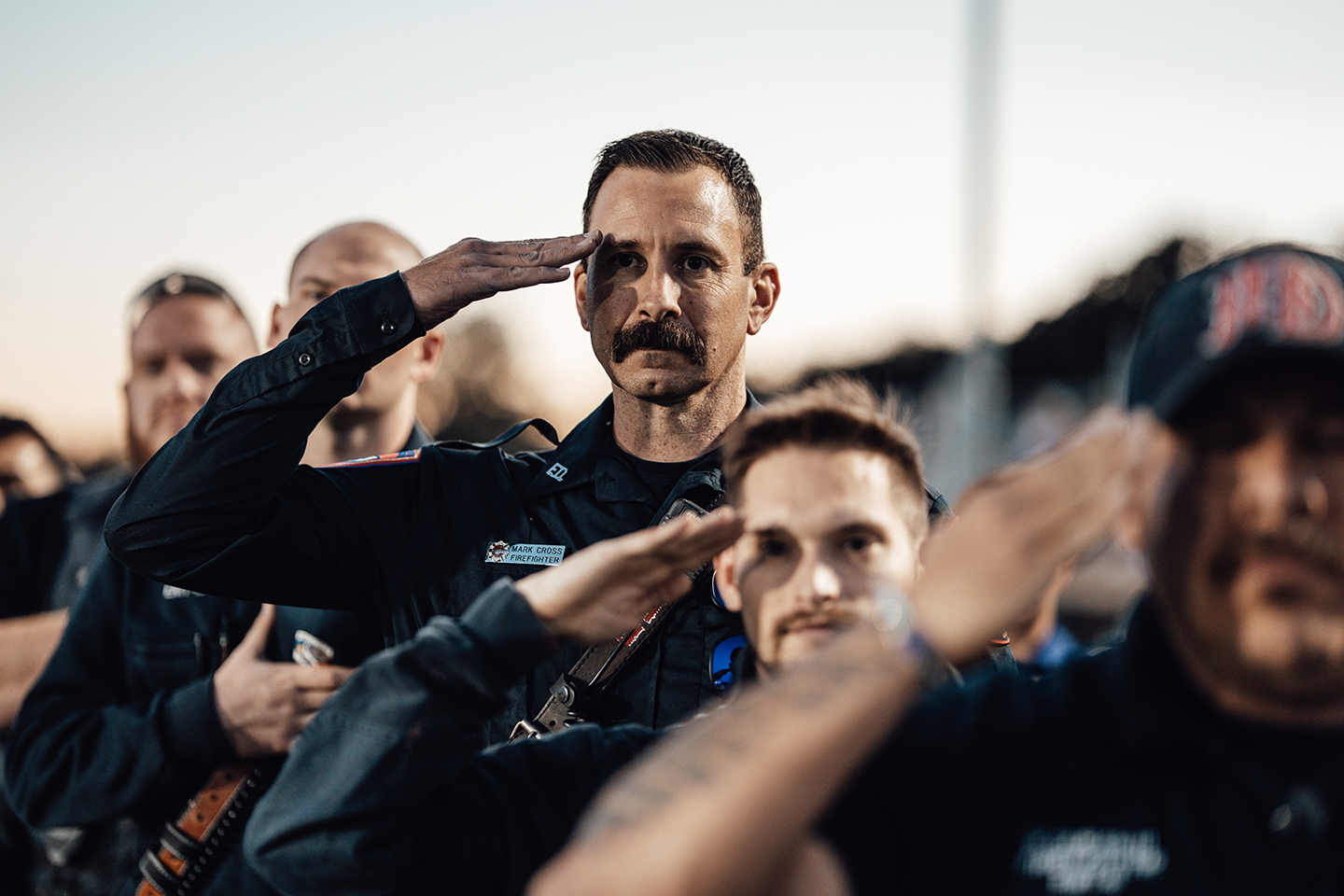
For Firefighter Mark Cross, service was not a career decision as much as it was a way of life shaped from childhood. He grew up in Kennedale, a small town on the southern edge of the DFW metroplex, where his parents’ example formed his earliest understanding of what it meant to help others. His father repeatedly impressed on him the importance of having a servant’s heart and using God-given talents for the benefit of the community. Much of Mark’s childhood was spent assisting at church, helping out at his dad’s office, or spending time at City Hall, where his mother worked.
Those hours at City Hall placed him in regular contact with the people who kept the community running. Firefighters, police officers, and librarians passed through daily, and to Mark, they were clear examples of leadership and service. Their consistency, their willingness to help, and the normalcy of their presence provided him with a living picture of what public service looked like. These early experiences did not just introduce him to civic life. They helped shape the values he carried into adulthood and ultimately informed the path he would take into emergency services.
Those seeds took root. But it was the early 2000s, during his studies in environmental technology and hazardous materials, that the world around him shifted his trajectory. The shock of September 11th and the loss of the Space Shuttle Columbia stirred something in him. When hazardous materials teams were deployed for the recovery effort in East Texas, and Cross had the opportunity to assist, he felt a pull toward emergency response.
A wildfire ecology class at the University of North Texas confirmed that pull. One elective turned into hands-on fire academy training, and soon he was taking part in prescribed burns with an informal university wildfire crew. The work felt right. It felt purposeful.
Cross spent several years as a FEMA Planning Section reservist, gaining deep experience in disaster management while deploying across the country. He taught at Comfort ISD and studied project management and business continuity. Eventually, he accepted an emergency management job in Austin, but the long commute pulled him away from family life in Boerne. He and his wife were raising six children, and they needed him home.
That reality led him to the Boerne Volunteer Fire Department in December 2016. He joined simply to see if this work might fit. Within a year, he put himself through fire school. In January 2020, he earned a full-time position with the Boerne Fire Department. The moment he stepped into that uniform, he knew he had arrived where he was meant to be.
“This is home,” he said. “It is where we live, play, and pray.”
Serving a Community That Still Feels Like a Community
Kendall County is growing, but Cross believes something essential remains. “Although the area is quickly growing, this community retains that small-town charm and feeling of being connected,” he explained. That sense of connection is what fuels him on every call.
Firefighting often brings adrenaline, but the daily reality requires steadiness and compassion. Medical calls make up the majority of the department’s responses. They demand patience, empathy, and the ability to create calm in the middle of someone else’s worst moment. Training provides the muscle memory needed when seconds matter, but many calls give firefighters the chance to slow down and be present.
“Our patient has to feel that we care,” Cross said. “Whether it is 3 p.m. or 3 a.m.”
Faith plays a role in how he approaches the work. Seeing destruction or loss on a regular basis can weigh heavily on a firefighter’s outlook, and faith helps him keep perspective. The bond around the station table helps too. Every shift begins with breakfast. Ten firefighters with different backgrounds and experience levels gather before the day begins. What unites them is a shared commitment to serve well.
His Confirmation Saint, St. Catald of Taranto, the patron invoked against disasters, has become a source of quiet reassurance. So has Proverbs 24:16, a verse recently reintroduced to him by a coworker and one that speaks directly to resilience.
The Person Behind the Uniform
Cross first connected with Hope for Heroes Texas through the organization’s monthly luncheons. The welcome was immediate.
“As soon as you walk through the door, you feel welcomed,” he said. “They always have a handshake, a smile, and food.”
For Cross, supporting the person behind the uniform means valuing the whole human. It means recognizing the spouse and children behind the scenes, the long nights, the emotional toll, and the sacrifices that do not make headlines. It means cultivating programs that strengthen responders and their families.
“First responders answer people’s worst day on most every call,” he said. Without community support, that reality would wear down even the strongest professionals. “But we are blessed here. No matter what patch is on our sleeve, this community stands with us.”
One of the moments that encourages him most is when a child recognizes him from Fire Prevention Month. “It reminds me that it is not just another presentation,” he said. “It was memorable, hands-on learning that will help keep them safe.”
Leadership, Legacy, and the Long View
Cross believes a good firefighter is built from both skill and character. Technical knowledge matters, but so do communication, empathy, and the ability to project confidence when someone is depending on you.
Years of response work have shaped him as a husband and father. “I know how fragile life can be,” he said. “I cherish every moment with loved ones.”
When he looks decades ahead, he hopes his legacy is simple. He wants to be remembered as someone who embodied a servant’s heart and inspired others to serve.
Asked to summarize his journey, he said it plainly.
“It was a journey home to serve the hill country.”
A Note from Brad Cornell, Founder of Hope for Heroes Texas
“Mark Cross represents exactly why Hope for Heroes Texas exists. He is a man who kept choosing service even when the road was not easy. What inspires me most is how deeply he loves the community he serves. Mark reminds us that heroes are not defined by uniforms or sirens. They are defined by heart, by humility, and by the steady commitment to show up for others every single day.”
From the January 2026 issue of The Kendall Gentleman.
From the Hope for Heroes series: For the Boerne Fire Chief who leads the department Cross is part of, read about Manny Casarez. For another Hero who came to the Hill Country from outside Texas and chose to stay, read about Officer Cody Shelton.