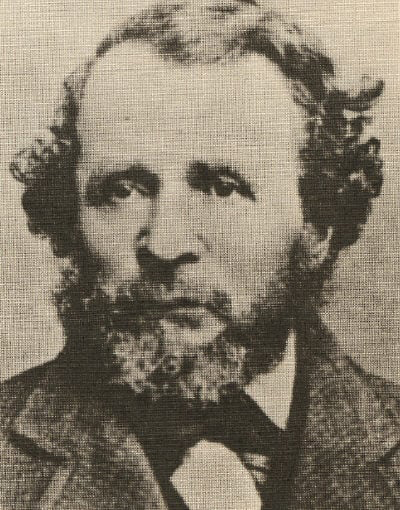
The Story of Christian Dietert
Christian Dietert (1827–1902) — Hill Country Miller, Builder & Pioneer
Have you ever wondered who laid the foundation for our busy Hill Country towns? The name Christian Dietert might not be on every street sign in Kendall County, but his story is a vital piece of our shared German-Texas heritage—a story of grit, ingenuity, and a few good floods!
While much of his famous work was just next door in Kerrville, Christian Dietert’s influence, and the work of his family, rippled right into Comfort and Boerne, helping turn the wild frontier into a thriving community.
- ✈️ Journey to Comfort: A Skillful Newcomer
Born way back in 1827 in Prussia (part of Germany), Christian was a master millwright and miller—a seriously high-demand job in the wild Texas of the 1850s. Imagine trying to build a town without a way to grind your grain or cut your lumber!
In 1854, he and his family sailed across the ocean and landed right here in the heart of Texas German settlement: Comfort. The Hill Country was a magnet for industrious German immigrants like the Dieterts, who brought their skills, their books, and their strong work ethic. Christian’s arrival was perfectly timed with the region’s desperate need for infrastructure.
- Taming the River: Innovation in Kerrville
Christian didn’t waste any time. He first tried his hand at a mill on Cypress Creek near Comfort, but early troubles (drought and floods—the typical Hill Country double-whammy!) taught him some hard lessons.
By 1857, he’d moved a little west to what became Kerrville. There, he and a partner built a game-changing grist and saw-mill on the Guadalupe River. What made it special? They built a low, diagonal dam right across a broad part of the river. This clever design was an early engineering marvel, allowing the mill to maximize water power even when the river was low—a brilliant solution to the unpredictable Texas water supply.
That mill quickly became the economic backbone of the fledgling town, connecting it by trade to places as far as San Antonio and even Mexico!
- The Kendall County Connection: It’s All in the Family
So, how does this relate to us in Boerne and Kendall County? Christian’s reach spread through his family.
- His brother, Wilhelm Dietert (also known as William), settled right here in Boerne!
- William established one of Boerne’s first businesses—a dam and a combined sawmill/grist-mill on the Cibolo Creek.
The Dietert presence across the county line wasn’t a coincidence; it shows a network of German brothers and projects, spreading essential skills and technology across the whole Hill Country. If you see the Dietert name in local history, it’s part of that shared, inter-county legacy.
- More Than Just Mills: Community Builders
Christian and his wife, Rosalie Hess Dietert, weren’t just about business. They were cornerstones of the community. They were instrumental in introducing German cultural traditions that are still part of our fabric:
- Social Dances and the Waltz
- The Christmas Tree tradition
Christian also stepped up as a civic leader, serving for years as the Postmaster of Kerrville and even as a County Judge for a time. He helped build not only the economy but also the social and civic life of the frontier.
- Why His Story Matters Today
Christian Dietert’s journey from a German millwright to a Texas civic leader holds a few key takeaways for us as Hill Country residents:
- Infrastructure is Destiny: In frontier times, a functioning mill was the difference between a town that died and a town that grew. Dietert delivered the necessary facilities for farms to thrive and homes to be built.
- Innovation Solved Problems: His dam design is a reminder that early settlers weren’t just hardy—they were brilliant engineers who adapted to the tough Texas environment.
- Cultural Roots Run Deep: When we celebrate our local heritage, we honor people like the Dieterts who brought the traditions of music, fellowship, and industry that make our small towns unique.
By appreciating the story of Christian Dietert and his brother William, we gain a clearer picture of how our comfortable, modern Kendall County emerged from the hard labor, smart ideas, and strong German immigrant networks of the past.
From the January 2026 issue of The Kendall Gentleman.
From the Hill Country archive: Dietert’s mill-building took its place among the work of other German pioneers like Nicolaus Zink and Jacob Luchenbach, whose journeys also led to the Texas Hill Country.