Published in 2011, the late John Eddie Vogt’s book, Witches, Bitches, and Other Small Town Folks, brings to life the quirky, unforgettable, and entertaining tales of growing up and living in Kendall County from the 1930s through the 1960s. Thanks to the gracious permission of his family, The Kendall Gentleman is honored to share excerpts from his book for your enjoyment.
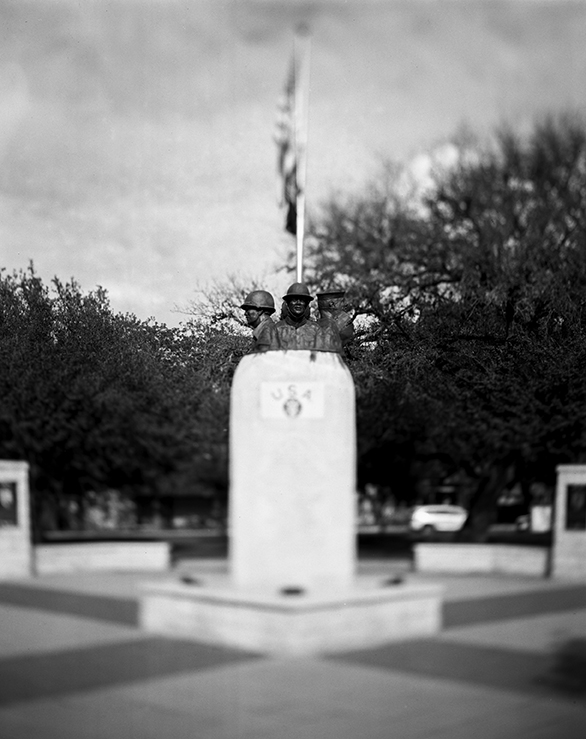
Veterans Park, which is located on South Main across from the Catholic Church, has an interesting past that just seems impossible to solve.
We know that “Boerne South Side of the Cibolo River” was being developed shortly after the War Between the States, or as the South called it, “The War of Oppression.” The original plat of Boerne was only laid out to about 200 yards south of the Cibolo. William Kernaghan had bought about 800 acres from Frederich (Frederick), from which “Boerne South of the Cibolo River” was a part of that which was being developed.
As a start, Kernaghan gave the area where St. Peter’s Church is today. Evidently there was a small building on the church property since such a building is recorded on the deed. The deed says that the building will be used for a school and a church.
At about the same time Kernaghan also gave what today is called Veterans Park to the city. On May 2, 1867 the park is referred to as “Union Square.” It seems logical that Mr. Kernaghan was a Union sympathizer and gave it this name in the gift. At some time the street now known as Hickman was named Lee. For how long the park was referred to as Union Square seems to be anyone’s guess. We do know that in the 1920s a rock monument was erected in memory of those from Kendall County killed in WWI. I feel that this is when it started being called Veterans Park. This is only an educated guess.
While Kernaghan was making the “subdivision” more attractive for development, he made a deal with J. Stendebach to dig a well “for the use of the people of Boerne south of the Cibolo.” On August 29, 1866, Mr. Kernaghan’s agent, Mr. O’Grady, deeded lots 27 and 28 to Stendebach on the condition that a well be completed by January 1, 1867. This well must be sufficient to furnish enough water for the people for a specified amount of time. Evidently the well was dug and met all of the requirements, as Stendebach later sold the lots he had received.
On Armistice Day (November 11) the schools would have a holiday. Everyone would gather downtown at the plaza and line up for a parade to Veterans Park. The VFW and American Legion would lead the parade. I always looked forward to seeing Arno Harz. After so many years his uniform still fit him. He had been a Marine, and he looked so sharp. Joe Ammann would lead the parade carrying the American flag. Joe was rather short and bow-legged but took longer steps than anyone else. It was worthwhile just to see him holding the flag high as he led the procession along. After the veterans would come the Boy Scouts, Girl Scouts, and school children waving their flags of assorted sizes. We would all march down Main Street until we got to Veterans Park where a ceremony would be held.
For years there was an old World War I cannon that was sitting just to the west of the memorial monument. Thank goodness it wouldn’t shoot as it was aimed right at St. Peter’s tower. During the war (WWII) the cannon was given as scrap to help in the war effort.
From the November 2025 issue of The Kendall Gentleman.
More from John Eddie Vogt: JEV is careful to separate Veterans Park from The Plaza, where Boerne actually held its public life. For another look at how the town used both spaces, read Christmas Celebrations.