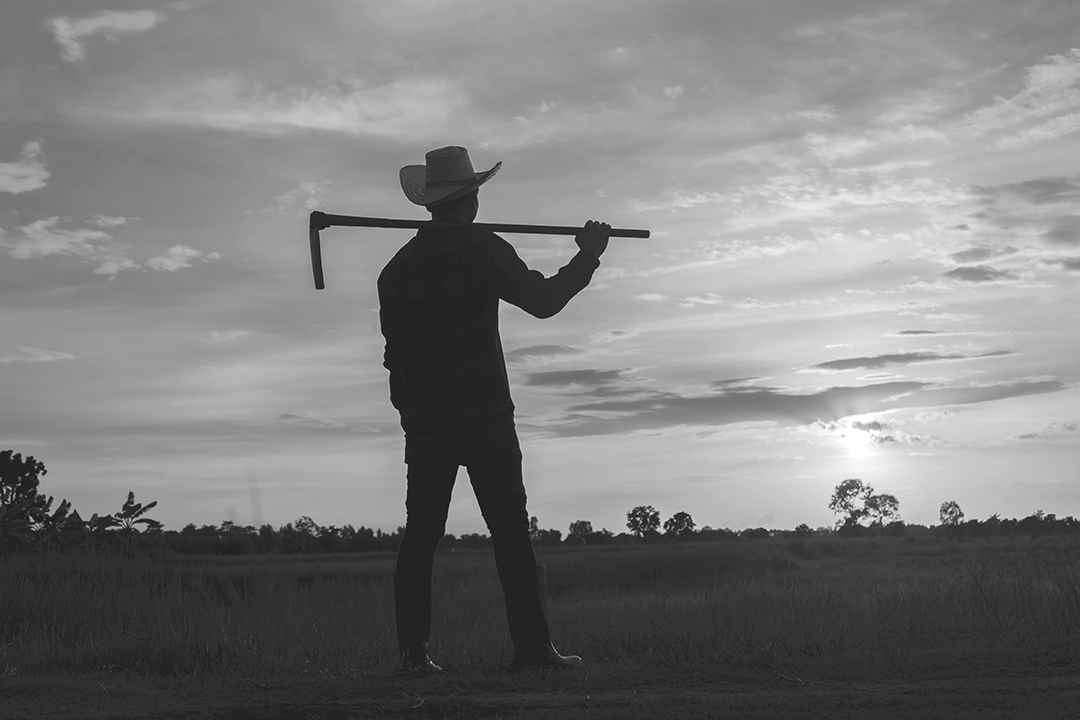
Willie enjoyed farming and was usually the first person to have his fields worked up each spring. He was a believer in the use of signs of the moon and zodiac in his farming and ranching. He planted, harvested, cultivated, everything by the signs. When he was dying I asked him if he would mind if I recorded him while he told me what all of the different signs meant. It was OK with him, so I set up a date. We talked about the fruitful signs and the barren signs, and he went into quite some detail. This was just a few years after the great drought of the 50’s. When it appeared that we had covered everything, he looked at me and said, “But hell boy, if it doesn’t rain those signs don’t mean a damn thing.”
Once I had several hundred sheep. They were lambing and every few days I would go out and castrate and cut off their tails. One day while doing this I noticed that they bled more than usual. When I came back to town, Willie was at the store so I mentioned to him what I had been doing. Immediately he stated that the sheep had probably bled a lot. When I admitted to the fact, he said the moon is in the wrong sign, that kind of work should only be done in the dark of the moon with the zodiac sign in the knee or foot. The next time I worked the lambs, I looked at the calender and watched for the dark of the moon. I went out, castrated and cut off the tails but they still bled quite a bit. When I came back to town I looked him up to tell him his theory was for the birds. He looked at me, laughed, and refraining from calling me stupid he said, “Sure the moon is in the dark sign, but you forgot to also look at the zodiac sign.” Sure enough, it wasn’t in the knees or the feet. From that day on, whenever I was going to castrate, dehorn, or cut lambs’ tails I looked at both the moon and zodiac signs. Don’t ask me how it works, but it does.
Uncle Willie had a shearing machine, or as they were sometimes called, a roaching machine. It was a hand-turned cutter that stood about four feet high with an arm several feet long and the cutter at the end of that arm. He had an old sheet in the workshop where he kept the shearer, and all of the neighborhood boys would come by for their haircuts. There was one old German gentleman who would also come out every three or four months for his haircut. Each time Mr. H. would be finished, he would reach down deep into his pocket and pull out an old snap-top purse. Reaching into the purse where he conveniently had a dime, he would hold the dime forward to Willie and in German ask how much he owed. Each time, Willie would decline payment. This went on time after time, year after year. One day after Willie had finished with the haircut, Mr. H. took out his purse and snapping the purse open, in Willie’s words, “He got this strange look on his face. As he was asking how much he realized that there was nothing in the purse except a fifty-cent piece. Evidently the thought ran through his mind that never in all the years had any money been accepted so holding the coin forward he asked ‘Vie fiel?’ I grabbed the coin and said, ‘Fifty cents’ and stuck the money in my pocket. The old man immediately left and never returned again for a haircut.”
From the August 2026 issue of The Kendall Gentleman.
John Eddie Vogt’s recollections continue The Kendall Gentleman’s Musings of JEV series, alongside earlier stories like Musings of JEV: Earl Wellborn and Felipe and the Schwarz Field. For more from this issue, read Bill Thomas’s story in The Man Who Built Joy.