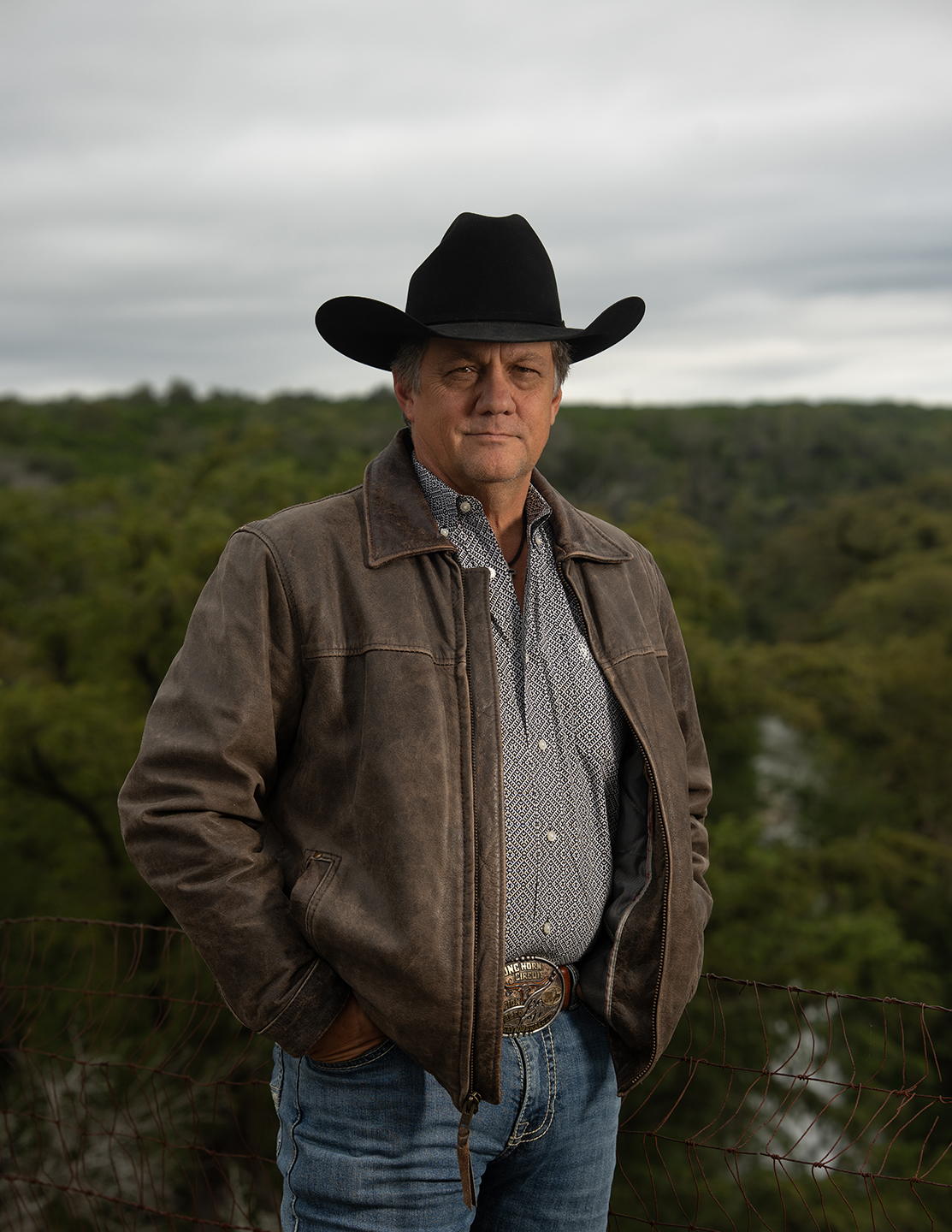
Glynn Praesel won his first buckle in Kendall County on the seventh bucking horse he ever climbed on. Forty-three years later, he’ll tell you he has failed more than he has succeeded, and that he is still more afraid of not living than of dying.
Glynn Praesel was 19 and on the seventh bucking horse of his life when he won the bareback riding in Kendall County. It was Labor Day weekend, 1983. “I still have the buckle,” he said. Forty-three years later, he told me the story two miles from that arena, as the crow flies, and the coincidence wasn’t lost on him. “It’s funny we ended up here,” he said, “where I won my first buckle.” A lot happened in those two miles.
Around Kendall County, people may know the short version: the rodeo cowboy, the Aggie, the man behind a company that does work all over the country, the bad guy in a Western they shot out at Enchanted Springs Ranch. Glynn has heard it, and he doesn’t buy it. “A lot of people say, ‘Glynn, everything you touch turns to gold,'” he said. “I’m like, no, you haven’t seen a lot of the stuff that’s buried in the closet, ’cause there’s a lot of stuff that’s lead back over there.”
Ask him about his life, and he won’t hand you a résumé. He’ll hand you a list of things that didn’t work. “I’ve failed at a lot, probably more than I’ve ever succeeded at,” he said. “It’s just that the success, for me, has been a little bit better than all the failures combined.” What keeps him climbing on is something he calls his mantra. “Look, I’m not afraid of dying,” he said. “I’m afraid of not living.”
He told me more than once that he didn’t want this story to be about him. He wanted it to be of some use to whoever reads it. That’s fair, and the useful part starts on a flight line in Florida.
He was born in Brownsville on November 25, 1963, the day the country buried John F. Kennedy. His dad taught high school math and worked in sales for Zales, and when Glynn was about three, Carl Praesel joined the Air Force to fly. By the spring of 1969, the family was at Eglin Air Force Base, and his dad was headed to Vietnam in an F-4. Glynn was five.
Before he left, his dad sat him down and told him the truth, which was that he might not come home. Then came the flight line, where Glynn remembers holding onto his father’s leg and begging him not to go, and his father having to push him off.
He still tears up telling it, and he’s careful not to fault a man who was telling his son the truth on his way to war. He offers it instead as a caution for the rest of us. “I think parents don’t understand how impactful some things are,” he said. “Being a parent is not a dress rehearsal,” he told me later. “Every day is the first day of them at that age.”
His mom took the kids to Corpus Christi to wait. Letters went back and forth, and so did cassette tapes. Glynn says he became the man of the family that year. His mother leaned on him to be strong, and he learned to rely on himself.
On Good Friday, March 27, 1970, the Corpus Christi Times reported that Capt. Carl E. Praesel Jr. was home. A red carpet had been rolled out on the sidewalk, a sign in the yard read, “The F-4 Has Landed Once More! Welcome Home,” and his fishing gear was laid out and waiting. A newspaper photo shows Glynn’s mom waiting on the front steps with the two youngest. Glynn isn’t in it, because he was at school.
“It was the greatest day in my life at that time,” he said. The fishing gear wasn’t for show, either. Father and son fished Corpus Christi Bay for trout all the time. “He loved to fish,” Glynn said.
The Air Force kept the family moving. Tampa came next, then Seymour Johnson in North Carolina, where his dad left for the war a second time, and Glynn spent his days “learning how to mow yards and ride your bicycle really well, building tree forts.” Then came Japan, and in 1976, home to Corpus.
In Corpus, he made friends with the surfers on his block and the bull riders too. His mother’s father was a cowboy, a rancher, and a deputy sheriff in Kenedy, and summers on that ranch made Glynn want to be a cowboy. He finished high school early and went to Texas A&M to study petroleum engineering, but it didn’t take. He left, came back, and left again, and in between he paid ten or fifteen dollars a head to practice on bucking stock. By Labor Day weekend of 1983, he was winning in Kendall County.
A couple of years later, he and a buddy left Corpus with about $400 to build houses for a man they knew in Michigan. They knocked on doors for work along the way and slept in the car, and when they got there, the man was gone. “I hocked a shotgun I had with me for sixty dollars,” he said, “so we could buy weenies and bread to survive until he showed up.” He figured he was wasting his life, and he said so to a friend who was a year from graduating. “He told me, ‘Glynn, you know how many of us would have loved to have done what you just did for the last three years of your life?'” he said.
In August 1986, with a credit card he couldn’t pay and no plan, he walked into the College of Agriculture at A&M and talked to Dr. Joseph L. Schuster, who ran the range science department. He told the professor he loved rodeo and the outdoors and had no idea what to do with himself. “I just need some direction,” he remembers saying. Dr. Schuster offered him a place in range science, with the option to transfer out if he didn’t like it. “I told him, ‘Dr. Schuster, let me in. I’ll get a degree here,'” Glynn said. “‘I want to finish what I started here at Texas A&M.'”
He paid for it at the sale barn. On sale days he ran cattle until midnight, slept there on a cot, loaded trailers when the buyers pulled up, and went straight to class at seven. He graduated in 1988. “You start something,” he said, “but you got to finish it.”
What came next looks like the part where the story straightens out: a sales job in Kansas, a friend’s wedding in 1989 where he first saw Denise, their own wedding on January 19, 1991, and a better sales job back in Corpus at about a hundred thousand dollars a year. Then one morning he got out of the shower and looked at himself in the mirror. “Man, I got a great job, making good money, and I hate it,” he remembers thinking. “I don’t like getting out of bed, and that’s not who I am.”
He walked to the phone and quit, even though Denise was pregnant. “For a few months, all I did was work driving tractors for a buddy for like ten dollars an hour,” he said. Later, he and a friend bought a 27,000-square-foot grocery store a mile and a half from an H-E-B, and that went about the way you’d expect. “It took me about a year to run that thing right into the ground,” he said.
He comes by the restlessness honestly. His father had been a math teacher, a salesman and a fighter pilot, and by the 1990s he was running a 24-hour appliance repair shop in Corpus. Glynn’s own turn came when a man showed up to clean his carpet. “I thought, man, I really want to keep my carpet clean,” he said.
So he bought a truck and put the man in it, and that was the start of Horizon Cleaning and Restoration. When a caller asked whether the company handled mold, Glynn said absolutely, though he knew nothing about it. He found someone who did, and he learned. More than two decades later, that company manages facility work across the country from Boerne. It’s the one people mean when they talk about gold.
He moved his family to Boerne in the early 2000s for the schools. Around 2008, a Western called “Palo Pinto Gold” was shooting at Enchanted Springs, and Glynn got cast as the bad guy. That runs in the family. In June 1980, when he was 16, the Corpus Christi Caller-Times pictured his father on stage at the Harbor Playhouse as the hired killer in “Dial ‘M’ for Murder.” Glynn has worked in independent films ever since, some of it stunt work. “When I was young, I got paid if I rode,” he said. “Now you get paid to fall off, and I’m old. It’s backwards.”
I met Glynn right around then, so I was around for what came next. Around 2010, a business deal went wrong. He had put his own money behind a run of big jobs and didn’t get paid, and he came close to losing the company. The man who had relied on himself since he was five could not fix it. “I finally went to my knees and said, ‘You know, God, whatever it is, whatever has to happen, I can’t fix this,'” he said.
He can’t tell you how it turned. “It was just every day,” he said. “I said, I’m going to get up tomorrow. I’m going to get up tomorrow. I got to get up tomorrow.” What he took from it is hard for a certain kind of man to hear. “As men, we are raised to believe that we have to. We are the provider. Without us, nothing’s going to happen,” he said. “I’m not saying that’s not true. What I’m saying is, without God, none of that matters.”
He had to let go of his anger at the people who had done him wrong, and he had to let go of the idea that it was all his to carry. “We should be giving it all to God when we have everything,” he said. “Sometimes we don’t give it all until we have nothing.”
“We should be giving it all to God when we have everything. Sometimes we don’t give it all until we have nothing.”
These days people bring Glynn their problems, and he has a theory about what helps. “Most of the time, what’s more beneficial is just helping people think through it,” he said. “My dad would sit and listen.”
He’s a Freemason and an Alzafar Shriner, and he volunteers as Camp Manager at Camp Alzafar, which the Shriners opened on the Guadalupe River in 1927. He takes men into the mountains on horseback, something he started with veterans. In April 2020, when his grandmother turned 99 in a Boerne retirement community during the COVID lockdown, he asked his fellow Shriners for a parade, and she got one. “I like being the guy that can help,” he said. “I just don’t need the spotlight.”
He’ll have to put up with a little of it here, because I’m one of the people he helped. I’ve known Glynn for going on twenty years, and he’s been a big brother to me for all of them. When I need to talk through something big, or need my walk with Christ strengthened, he’s who I go to. He’s the reason I went back to school, and the reason it was Texas A&M.
“If we would just learn from the people before us,” he told me, and he means it. Once I was enrolled, he came to visit and gave me a tour of his Texas A&M, the one he knew as a student. Then he took me to meet Dr. Schuster. Dr. Schuster died in 2018, and I got to meet the man who opened that door because Glynn took me to him. I have never left a conversation with Glynn without wanting to run through a brick wall.
Before we finished, I asked him the two questions I ask every cover subject. The first was his advice for the men of Kendall County. “Don’t ever miss an opportunity to let your family know you love them, because you don’t know what you have left,” he said, “and the thing that they remember when you’re gone, and they can pass down is love.” He doesn’t stop at family, either. “I think the sign of a real man is to be able to tell him, ‘I love you, brother,'” he said. “I’ll meet somebody, shake their hand. The second time, you’re probably getting the hug from me.”
For the young men, he went back to the years he once thought he’d wasted. “Don’t rush life,” he said. “Don’t try to put your life in a box.” Then he told me something I didn’t expect from a grandfather about to turn 63. “I still climb trees, Michael,” he said. “Why? ‘Cause that’s my youth, man. I ain’t letting it get away from me.”
He and Denise have two daughters he describes as strong-willed, independent women, and grandchildren now. Next year the two of them plan to finish seeing all seven continents, with Antarctica last. The man who started on his seventh horse is about to finish his seventh continent, and home is two miles from the first buckle. He’d rather you not make much of it. “If there’s anything anybody ever said over my grave, I hope it ain’t about me,” he said. “I hope it’s about what he did for me, what Jesus Christ did for me.”
So take the part he wants you to have: tell your people you love them, don’t rush, and hand it over before you have to. “Don’t ever quit climbing trees,” he said. That is why Glynn Praesel is The Kendall Gentleman.
From the November 2026 issue of The Kendall Gentleman.
For more from this issue, read Jed Mazour’s Sing Us a Song, a hunting-trip reflection on faith and strength, and Brady Lastinger’s story in A New Home and a New Calling. For more cover stories on Kendall County men, read Wes Holekamp: The Long Road Home and The Man Who Built Joy.