I have done my best to explain how unforgiving the terrain is. I have emphasized the uncomfortable fact that there is only one way in and one way out. Rain or shine, cold northern winds or hot, stale summer air, we have no control. The realities of an excursion like this have been conveyed to the best of my abilities. No one can say, “I didn’t know!”- that’s how clear this has to be. In my experience traveling these rivers the way we do, most people will not commit. They make excuses often disguised as reasons, like a recent family situation, a sudden health concern, or a last-minute work conflict. Whatever the reasoning, the group whittles away little by little until there is only a fraction left. I know life interferes, but what I am trying to say is that the average “outdoorsy” guy will almost always cancel his commitment. This time, however, is much, much different.
It’s about 5 p.m. and we are just rolling into Marlene’s place outside of Del Rio, Texas. It’s been a little while, and I was excited to introduce Marlene to everyone. The first things people notice are her pet turkeys, guineas, and strangely large roosters. They are really cute—until around 4 a.m. Soon enough, Mike Naccarato with Far West Texas Outfitters makes his way over to introduce himself. Although Mike and I have never floated together, we have been brainstorming this trip for a while. Mike is a character blend of East Austin and Alpine West Texas: cool and slightly trendy, but rough and resourceful. Definitely a guy you want to befriend. Adam works for Far West Texas Outfitters and joined our trip as well. He is a much more quiet, but extremely knowledgeable and calculated guy. When he talks, you better listen, because you are probably about to learn something.
With the sun setting behind the mesquite trees and pila, you can smell the smoke from the BBQ pit. The next handful of hours are spent cooking fajitas, prepping our gear, storytelling, and calming any nervousness you might still have. There is really something special about the evenings at Marlene’s. Sometimes I get a sense this is one of those moments in life I captured at just the right time. Things come and go, people move on, times change, and so does our environment. But today, things are perfect.
Me, Denise (my wife), Matt Riebel, Erin Smith, Hunter (my son), Chad Sill, and Rusty Chiles: The Rough Riders. Well, not quite, but for the sake of this story, let’s go with it. Seven canoes and one kayak. About 3,500 pounds of gear, people, and boats. We are embarking on a four-day voyage into unknown territory—at least as far as we are concerned. From Marlene’s to our drop location is about a two-hour drive. It’s not the distance, but rather the ranch road conditions that make the trip so time-consuming. As we make our way across the dusty desert, you can start to see what looks like a drop in the landscape. I knew exactly what was coming, so I made sure everyone was ready to soak in what was about to appear. If you’ve ever seen an old western movie where a cowboy and his horse are at a full gallop and suddenly pull the reins just before running off a cliff—well, this is it! At the bottom of this three-hundred-foot cliff is a secret oasis. It is almost like an artery that pumps just enough to keep its dependent wildlife alive in a volatile environment. The water is a rich emerald green that strikes a beautiful contrast against the aged, gray rocky cliffs that line the banks. Above the gray is the vast, endless bluebird sky. You don’t have to be an artist to imagine this scenery, but you might wish you were one so you could paint the memory.
Due to our arrival time, the decision was made to set up camp at our drop location and push off in the morning. This wasn’t bad news. Right above our camp is an area the size of a football field covered in petroglyphs (images carved in the limestone) and about a mile or so of cold, clear, deep water. This was my second time investigating the petroglyph site. It’s puzzling staring at so many drawings and not being able to understand exactly what they are trying to communicate. Some are obvious—arrowheads, bows, handprints, and such—but the amount of random circles, connecting lines, and shapes will certainly leave you perplexed. I’m beginning to think I have a reasonable idea of what they mean, though. I will tie that in later in my story.
The next morning, we were eager to push off and get started on our 23-mile expedition. Right away, we hit our first set of rapids. They were fairly easily negotiated, but a few people took the high route and portaged. If you don’t kayak much, I should explain: after each rapid, the water dumps into an eddy, or deep pocket of water. This is always a prime location to stop and spend some time fishing or swimming. Making our way slowly downriver, we frequently came across this pattern of rapids and eddies. You start to know what to expect pretty quickly. Although you never knew just how big and fast-moving the next set of rapids were going to be, that was part of the excitement!
On day two, our guide, Mike, log-jammed his canoe in some pretty serious water but was able to retrieve it without any major issues. I am not sure why, but after I saw that, I decided to give it a try myself. It was not a normal decision for me, as I typically lean toward caution. As soon as I committed downward, I’ll be honest, I was doubting myself. But there was no time for that! Heading straight for the same rock Mike jammed on, I put my leg out and kicked off to change my direction just in time, sending me perfectly down into calmer water. Whew! That was a close call and I knew it. It was time to focus a little more on my decision-making.
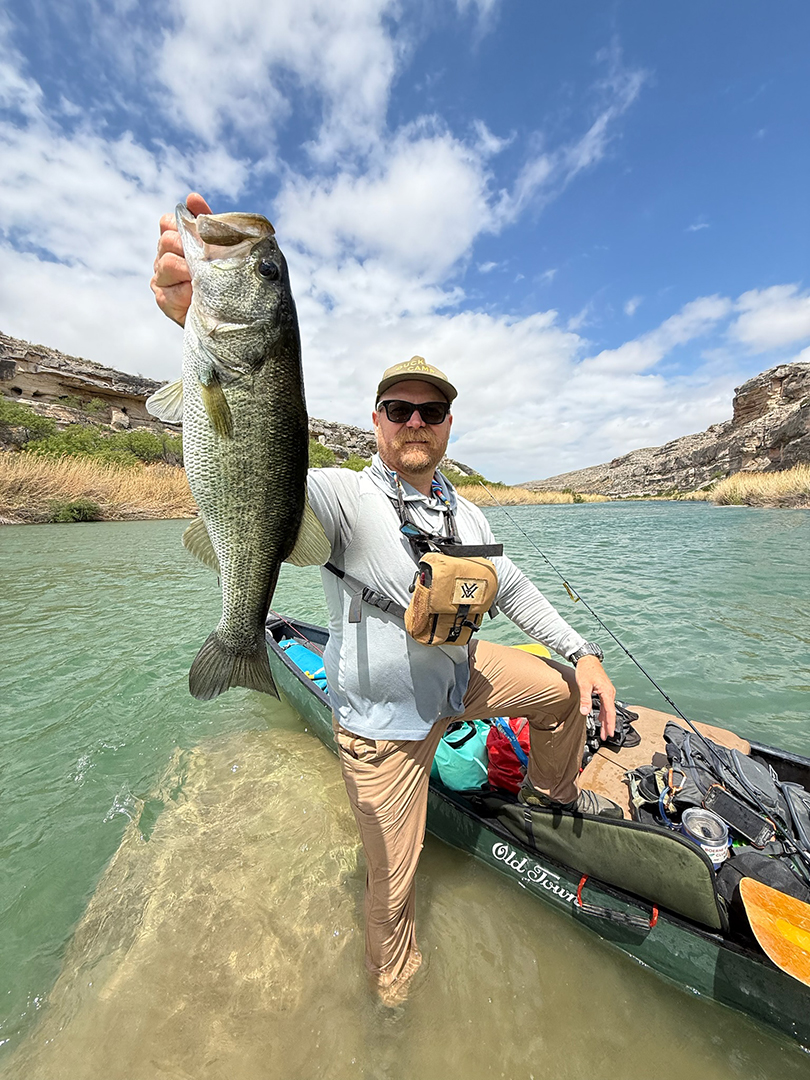
Each day was a new episode, and each episode was filled with bass fishing. The water clarity was a concern of mine coming into the trip. If you can see them, they can see you, and that typically means easily spooked fish. That is not applicable on the Pecos. This place is so remote and unpressured that the fish have absolutely no idea what to think about you or the tackle you are using. Translation: excellent fishing! I would estimate the total number of bass caught on this trip to be somewhere in the 150–200 range. The best part was that it became normal to catch fish in the 3-to-5-pound range as we progressed downriver.
On day three, the canyon walls started to close in, making it much easier to look for pictographs and cutting down some of the north wind. This really made things feel surreal. I began to imagine that this might have been a vulnerable feeling for the Indigenous people walking the riverbed. As you lift your chin to see the tops of the cliffs, you can sense that danger from above was surely an instinctual concern.
As we drifted ashore to portage around a rapid, we noticed what I can best describe as a grotto at the base of a small tributary leading into the river. It was a perfect circle of calm, clean, deep water. This MUST have been where they leisurely swam or bathed; you couldn’t possibly find a prettier or more convenient spot! Naturally, we made a few casts in the pool before swimming. Some of our biggest bass were caught in and around this area.
Mike let us know that if we climbed up about 30 yards, there was a large painting in a cave just above the kayaks. As we reached the cave entrance, you were immediately face-to-face with a 15-to-20-foot long painting. To me, it appeared to be some sort of calendar. These pictographs that line the Pecos River for miles and miles are as old as 5,500 years—some of the oldest paintings in the entire United States. Against the wall, you can still see where they burned their fires, leaving the stone black from the smoke. A large pile of flint tailings filled the edge of the cave. Standing there, you could close your eyes and imagine a family thousands of years ago tending a fire, working on arrowheads, and children swimming in the grotto below. From this position, they could work, cook, and watch anything approaching from up or downriver. I got the feeling that tribes would make long, tortuous journeys to get to these cave locations, maybe seasonally or for ritual reasons. But the fact that they returned for thousands of years, leaving their stories in paintings on top of paintings from thousands of years prior means this place was important. Eventually, we all found ourselves on our hands and knees, sifting our fingers through the cool, powdery dry sand, hoping to find some kind of artifact. Then it happened. I noticed a sharp angle on a small stone. I reached down and slowly picked it up. It was a small arrowhead, about the size of a woman’s fingernail, in almost perfect condition! It was so small I could only imagine it was used for birds or tiny rodents. What an incredible moment!
At night, we shared stories, passed around good whiskey, and watched Hunter tend to his lines for catfish. The campfire illuminated the canyon walls with a beautiful, deep orange. The dark silhouette of the rocky riverbed flickered in the light. Steep walls on both sides of the river provide a window to the galaxy above. Lying there on your back, you can watch the constellations move across the night sky with the Earth’s rotation: the handle of the Big Dipper pointing to the North Star, Orion with his mighty saber, and countless others. it is a live view of an endless universe. Then I realized: the circles, connecting lines, and characters at the petroglyph site are images of what the Indigenous people saw in the starlight canvas. At least, that’s my take.
I’ve enjoyed writing these articles and telling some of our stories. It always makes me smile when someone says they took the time to read it, but I think the most enjoyable part has been exploring ways to explain it in my own words—not for creative reasons, but in hopes that someday my grandchildren, and maybe their kids, will enjoy reading the stories of our lives. Maybe it will feel a little familiar to them the next time they pick up a fishing rod and gather around a campfire.
Cheers!
Jed Mazour
From the June 2026 issue of The Kendall Gentleman.
From the Texas outdoors: if the Pecos gets under your skin, it doesn’t let go. For another encounter with the same river, read The Mighty Pecos and The Singing Shaman. And for another wild Texas waterway that demands everything you’ve got, Devil’s River covers it in full.