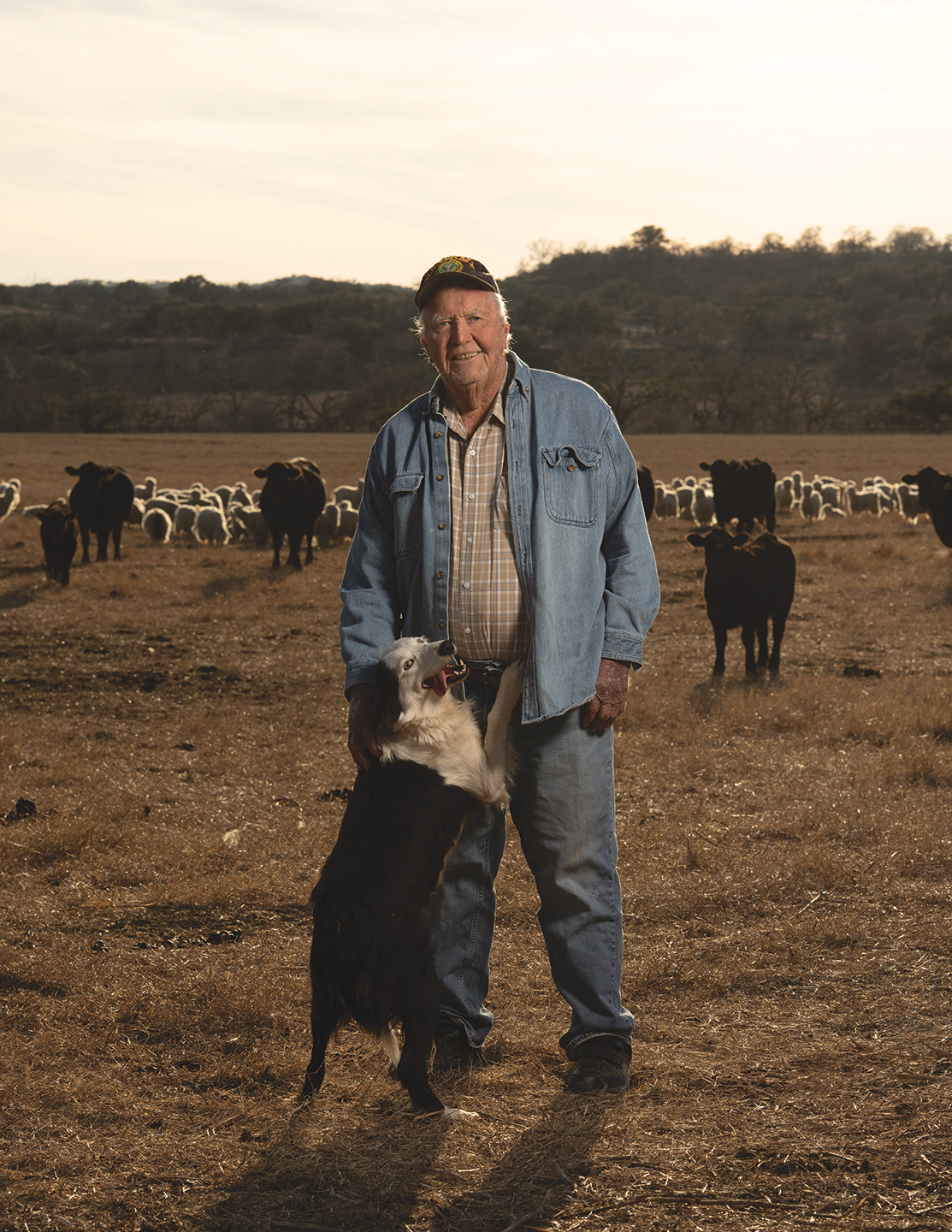
There are men whose names end up etched into stone, and there are men whose work becomes so foundational that no one remembers who laid it in the first place. William “Bill” Whitworth belongs firmly in the latter group. His life does not read like a résumé. It reads like a ledger. Work done. Responsibility assumed. Problems handled before they became disasters.
Bill is a lifelong rancher in Sisterdale, a veteran, the first chief of the Sisterdale Volunteer Fire Department, and a former Kendall County Judge. Those titles matter, but they are not the story. The story is how those roles were carried. Quietly. Consistently. Without expectation of recognition.
Spend time with Bill and you quickly understand that he does not think in terms of legacy. He thinks in terms of obligation. What needed doing. Who was willing to show up. Whether the job got done right. Everything else is secondary, bordering on unnecessary.
Bill grew up shaped by the land and the work it demanded. Ranching was not something he discovered later in life or adopted as a lifestyle. It was the environment that raised him. Days were structured by weather, livestock, fences, water, and time. The land did not care about intentions. It responded only to attention.
Ranching teaches lessons early and often. Things break. Animals get sick. Fences fail. Water runs dry. Droughts arrive without apology, and storms arrive without warning. If you ignore a problem because it is inconvenient, it will return larger and more expensive. Over time, the land teaches you to see what matters and to act before small problems grow teeth.
Those lessons form a particular kind of man. One who does not panic easily. One who understands that consistency beats intensity. One who knows that real responsibility rarely announces itself.
That mindset followed Bill everywhere. Whether managing livestock, organizing volunteers, or navigating county government, he approached challenges the same way. Learn the terrain. Understand the people involved. Do the work yourself before asking others to do it.
“The land will tell you what it needs,” Bill says, “if you’re paying attention.” He could just as easily be talking about a community.
Like many men of his generation, Bill left home to serve his country before returning to build a life. Military service did not change who he was so much as sharpen what was already there. Discipline mattered. Structure mattered. But more than anything, accountability mattered.
When something failed, someone owned it. When a job needed doing, someone stepped forward. Bill carried that expectation home with him.
Returning to Kendall County, he did not retreat inward or focus solely on his own ranch. His sense of duty extended beyond his fence line. Ranching teaches you to take care of what is inside your gates. Community service demands that you care just as much about what lies beyond them.
That belief became action with the formation of the Sisterdale Volunteer Fire Department.
At the time, rural fire protection in much of western Kendall County was thin. Response times were long. Equipment was limited. Fires were often handled by neighbors with whatever tools they had on hand. It was not ideal, but it was reality.
Rather than complain about the gap, Bill helped organize a solution.
The department was built the old way. Volunteer hours. Donated equipment. People willing to leave dinner tables, jobs, and beds when the call came in. Bill became its first chief not because he wanted the role, but because someone had to coordinate the effort.
“We didn’t have much,” he says, “but we had enough people willing to show up.”
That sentence tells you nearly everything you need to know about how rural institutions survive. They do not survive on budgets alone. They survive because people decide that the safety of their neighbors is their responsibility.
Bill’s path of service eventually led him to the role of Kendall County Judge. In some places, that position comes with ceremony and political theater. In Kendall County at that time, it came with practical expectations.
This was a period when growth pressure from San Antonio was beginning to creep up I-10. Roads, emergency services, land use, and infrastructure all demanded attention. The Hill Country was changing, and not all of that change felt thoughtful or well considered.
Bill approached the job the same way he approached ranching and fire protection. Learn the ground truth. Listen to the people who live there. Make decisions that make sense on the land, not just on paper.
He governed close to the people. Folks knew where to find him, and they knew they would get a straight answer. More importantly, they knew whether he had done the work himself before asking others to do it.
In a place like Kendall County, that matters. Titles might earn you a chair, but competence earns you trust.
“You don’t lead from behind a desk out here,” Bill says. “People know if you’ve done the work or not.”
Bill was not interested in politics as performance. He was interested in outcomes. Roads that worked. Emergency services that responded. Decisions that could be explained face-to-face without spin.
One of the clearest windows into Bill’s character comes not from him, but from his daughter, Wynne. She joins the conversation occasionally, not to correct him or embellish his story, but to quietly confirm it.
“That’s just how he is,” she says. “He never thought of it as special.”
It is not said with irony or pride. It is said as a matter of fact.
For Bill, service was never an identity. It was continuity. You did what needed doing because it was your turn to do it. You did it well. And you trusted that the next generation would learn by watching.
Bill worries about what gets lost when growth outruns memory. Volunteerism. Local knowledge. A sense of mutual obligation. These things cannot be rebuilt once they are gone.
Bill does not romanticize the past. He is not interested in going backward. He is interested in not forgetting what works.
Volunteer fire departments matter. Local leadership matters. Neighbors knowing one another matters. These are not abstract values to him. They are practical ones. They are the difference between a fire contained and a home lost. Between a county that functions and one that fractures.
Ranching teaches that stewardship is active work. Fences need checking. Water needs monitoring. Land needs rest. Communities are no different. They weaken when responsibility is outsourced entirely to systems instead of shared among people.
Leadership, in Bill’s view, is proximity-based. You cannot lead people you do not know. You cannot make good decisions about land you have never worked. You cannot serve a community you only engage with during meetings.
At the end of the interview, Bill is asked the same two questions that every cover subject of The Kendall Gentleman is asked.
What advice would you offer to the men of Kendall County?
And what would you offer to the young men coming up behind them?
Bill answered thoughtfully in the moment. But like many men who are more comfortable doing than talking, the questions lingered.
Later, after some time had passed, Bill’s daughter sent me a message. She explained that Bill had been turning the question over in his mind. He wanted to sharpen his response.
“There is no end to the good you can do if you don’t care who takes the credit.”
It is a simple sentence. It is also a demanding one.
It asks men to act without applause. To serve without branding. To build things that may never carry their names. In Bill’s case, it is not aspirational language. It is a description of how he has lived.
Bill Whitworth will likely never think of himself as remarkable. That is fine. Kendall County does not need more men chasing recognition. It needs more men willing to do the quiet work that keeps everything standing.
Fire departments. County roads. Ranch fences. Community trust. These things endure because men like Bill decide they matter.
The work continues. And because of men like him, so does the county.
Although our work continues as we search each month for the next cover story. For now, we pause to recognize William “Bill” Whitworth as The Kendall Gentleman.
Key Facts
- Full name: William “Bill” Whitworth
- Hometown: Sisterdale
- Roles: former Kendall County Judge; first chief of the Sisterdale Volunteer Fire Department; lifelong rancher; veteran
- Issue: March 2026
From the March 2026 issue of The Kendall Gentleman.
More from The Kendall Gentleman: the men who hold things together rarely seek recognition for it. For another who fits that description, read Ed Heath: A Lifetime of Service and Leadership. And for a story about the work ethic behind the county’s quieter institutions, The Legacy of Service: Collins Martin is a fitting companion.